Jio Platforms Ltd (JPL) opens its IPO on 21 October 2026. The issue is a fresh issue of up to 27 crore shares at ₹1,065–1,119, with no offer for sale. At the cap price it raises ₹30,213 crore, the largest IPO India has seen, and values the company at about ₹10.30 lakh crore after the issue.
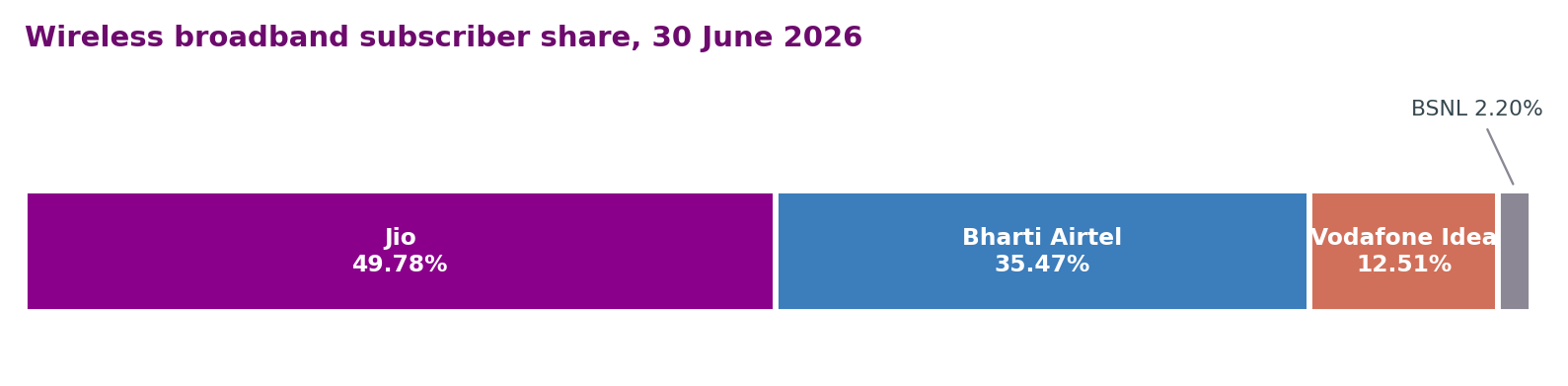
The business you buy today is a telecom operator, and a very good one. RJIL serves 533.3 million customers, holds 49.78% of wireless broadband subscribers and carries about 60% of India's mobile data. FY26 EBITDA was ₹76,255 crore at a 51.9% margin, and capex is finally coming down. Against Bharti Airtel, the only clean listed peer, Jio is cheaper on P/E (34.3x vs 40.7x) and dearer on EV/EBITDA (14.8x vs 10.8–12.8x). Our peer-based value is ₹957–1,329, centred near ₹1,150. That is fair, and only just above the cap.
The RHP describes something bigger: an "AI-native" technology platform, a 1,600-satellite constellation, 6G, and selling Jio's 5G stack to other countries. We went through each of these in the RHP and checked them against outside sources. Our conclusion is less exciting than the pitch. The AI economics sit mostly with Reliance Industries: Reliance Intelligence, the Jamnagar AI data centres and the Meta joint venture are all outside JPL, and Jio's role is to distribute them. The satellite plan has no disclosed cost and no funding in this IPO. 6G will bring a new spectrum and capex cycle around 2029–30. On overseas sales, the RHP says plainly that Jio has "not yet commenced" monetising its stack abroad.
Two levers do move the numbers in the next two to three years. Each ₹10 rise in monthly ARPU is worth about ₹5,900 crore of EBITDA, roughly ₹82 a share. Home broadband customers grew 43% in a year. Neither lever needs a heroic assumption. So we recommend APPLY for long-term investors. The core business is fairly priced, and the upside from tariffs and home broadband comes at no extra cost. Anyone paying more than fair value for the AI or satellite story should be careful.
Post-issue shareholding is our calculation: pre-issue holdings (RHP, p.108) divided by 920.90 crore post-issue shares. "Other pre-IPO investors" are PIF, KKR, Vista, Silver Lake, Mubadala, General Atlantic, ADIA, TPG, L Catterton, Intel, Qualcomm and smaller holders. The price band, lot size and listing date come from the company's 14 October 2026 announcement as reported in the press; the RHP leaves them blank.
This IPO raises fresh money; nobody is selling. Reliance, Meta, Google and every private-equity and sovereign investor keep their shares, and their stakes fall by 2.93%. That is unusual for an Indian mega-IPO. Hyundai and LIC were pure offers for sale.
| Particular | Details |
|---|---|
| Company | Jio Platforms Limited (promoter: Reliance Industries Limited) |
| Issue type | Fresh issue of up to 27,00,00,000 equity shares of ₹10 face value. OFS: nil. |
| Price band | ₹1,065 – ₹1,119 per share |
| Issue size | ₹28,755 crore at the floor · ₹30,213 crore at the cap |
| Anchor bidding | Monday, 19 October 2026 |
| Issue opens / closes | Wednesday 21 October / Friday 23 October 2026 (UPI mandate cut-off 7:00 pm, 23 Oct) |
| Allotment / listing | 26 October / 28 October 2026 (tentative), NSE (designated exchange) and BSE |
| Net issue split | QIB not more than 50% · NII not less than 15% · Retail not less than 35% |
| Employee reservation | Up to ₹500 crore, with a ₹54 per share discount |
| RIL shareholder reservation | Up to ₹2,500 crore for eligible Reliance Industries shareholders. They can also bid in retail or NII. |
| Retail bid range | 1 lot (12 shares, ₹13,428) to 14 lots (168 shares, ₹1,87,992) at the cap |
| Shares pre / post issue | 893.90 crore / 920.90 crore |
| Lead managers / registrar | 20 BRLMs led by Kotak Mahindra Capital · KFin Technologies · Monitoring agency: Crisil Ratings |
Source: RHP dated 14 Oct 2026 (cover, pp. 72–73, 116–125, 529). Price band, lot, employee discount, allotment and listing dates: company announcement as reported by Business Today and Chittorgarh, 14 Oct 2026.
Up to ₹27,500 crore will be used to prepay RJIL's external commercial borrowings, which were taken for 5G capex and spectrum. The rest goes to general corporate purposes, capped at 25% of gross proceeds. The detail matters: the RHP shows these loans cost 1.40% to 5.13% a year. Jio is repaying its cheapest debt. The annual interest saving is somewhere between ₹385 crore and ₹1,411 crore, against FY26 finance costs of ₹8,653 crore. The real gains are less foreign-exchange risk and a cleaner balance sheet before the next spending cycle, which we discuss in section 3. Earnings will not jump because of the debt repayment.
The RHP calls JPL a technology platform with connectivity as its "foundational layer". The financials say telecom. RJIL produced 87.7% of FY26 revenue, the company reports one operating segment, and the RHP admits that digital connectivity is "substantially all revenue". Prepaid mobile alone was 77.1% of revenue.
That telecom business is formidable. It has 503.6 million mobile broadband users, 284.9 million of them on 5G standalone, which is the world's third-largest 5G base. It has 28.6 million home broadband customers, more than anyone else in India, of which 14.0 million came through JioAirFiber within about three years of launch. It has 26,800.8 MHz of spectrum with 15.8 years of average life left, access to 3,60,537 towers and over 10 lakh route-km of fibre, and it is the only Indian operator with 5G spectrum in the 700 MHz, 3300 MHz and 26 GHz bands. Of 7,220 patent applications, 1,043 have been granted.
Revenue is subscribers multiplied by ARPU. ARPU rose from ₹181.7 (Q4 FY24) to ₹215.6 (Q1 FY27), and most of that came in one step, the industry-wide tariff increase of mid-2024. Since then ARPU has grown about 3% a year. Data use per customer is 43.7 GB a month, and monthly churn improved to 1.61% from 1.84%.
| Metric | FY24 | FY25 | FY26 | Q1 FY26 | Q1 FY27 |
|---|---|---|---|---|---|
| Revenue from operations | 1,09,558 | 1,28,218 | 1,46,885 | 35,032 | 39,173 |
| EBITDA | 54,959 | 64,170 | 76,255 | 18,135 | 20,865 |
| EBITDA margin | 50.2% | 50.0% | 51.9% | 51.8% | 53.3% |
| Depreciation & amortisation | 22,103 | 24,138 | 27,249 | 6,479 | 7,458 |
| Finance costs | 4,048 | 4,905 | 8,653 | 2,105 | 2,980 |
| Profit after tax | 21,423 | 26,109 | 30,049 | 7,110 | 7,764 |
| Diluted EPS (₹) | 23.93 | 29.17 | 33.59 | 7.95* | 8.68* |
| Return on avg. net worth | 8.02% | 8.97% | 9.42% | 2.31%* | 2.30%* |
| Return on avg. capital employed | 12.83% | 12.50% | 10.76% | 3.01%* | 2.56%* |
| Cash capex | 53,510 | 44,268 | 34,184 | 12,048 | 4,184 |
| EBITDA less cash capex | 1,449 | 19,902 | 42,071 | 6,087 | 16,681 |
*Not annualised. Source: RHP pp. 43, 76, 129–132.
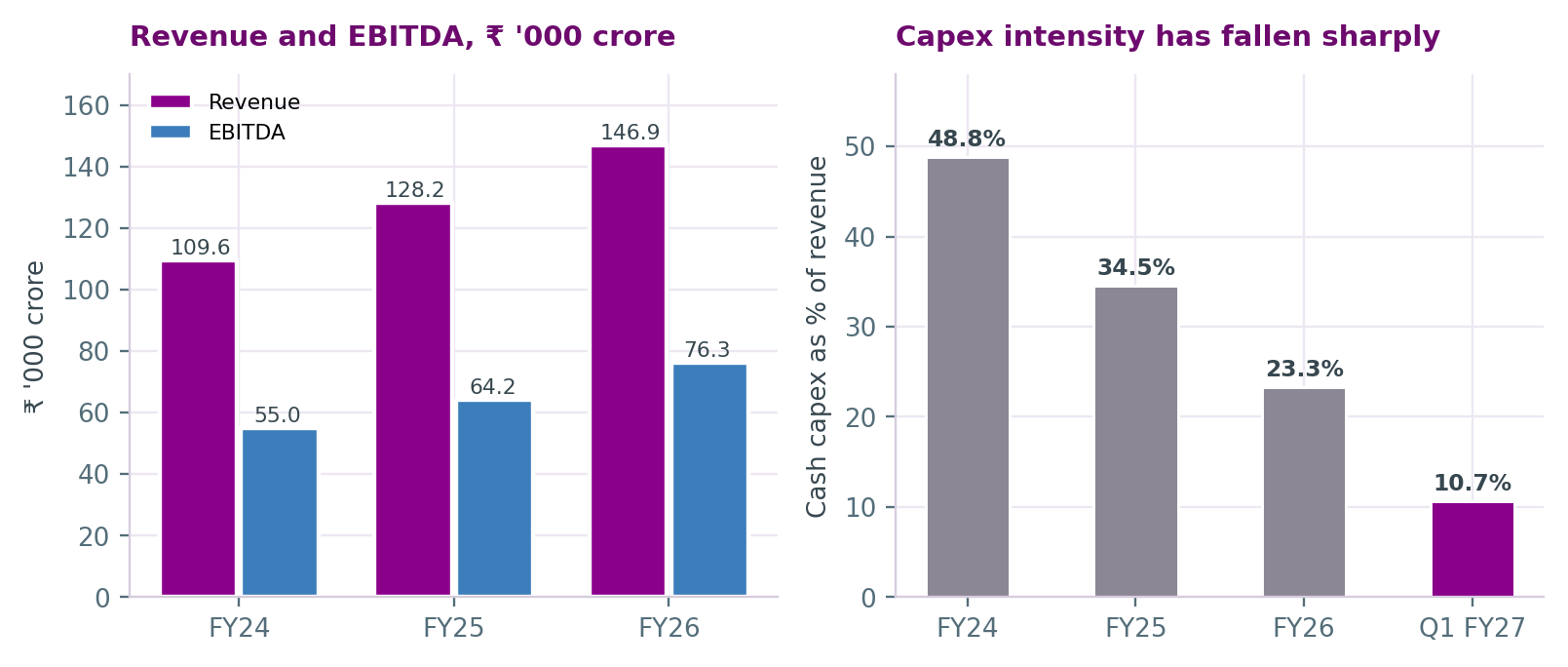
Three things in these numbers deserve attention. First, profit is lagging EBITDA. Q1 FY27 EBITDA rose 15.1%, but PAT rose only 9.2%. The 5G assets have moved off the "under construction" line, so interest that used to be capitalised now hits the P&L: finance costs rose 76.4% in FY26. Second, FY26 got an accounting boost. Jio lengthened the useful life of some network assets from 16 to 18 years, and the RHP says FY26 pre-tax profit would have been ₹1,840.5 crore lower without the change, about 4.6% of PBT. Third, cash taxes are close to nil: ₹118 crore of current tax in FY26 against a ₹10,182 crore deferred charge. That is good for cash flow, but reported PAT already deducts tax at close to the normal rate.
On Jio's own definition, net debt was only ₹9,539 crore in June 2026. That definition leaves out ₹1,04,514 crore of deferred spectrum dues and ₹12,168 crore of leases, both of which Airtel and Vodafone Idea include. On a like-for-like basis Jio's net debt was about ₹1,26,221 crore before the IPO, or roughly 1.7x EBITDA, and about ₹96,000 crore after it. We use the like-for-like figure throughout.
| Q1 FY27 (quarter to 30 Jun 2026) | Jio Platforms | Airtel (India ex-towers) | Airtel (consol.) | Vodafone Idea |
|---|---|---|---|---|
| Customers (million) | 533.3 | 491.9 | 680.9 | 193.1 |
| Net additions in quarter (million) | 8.9 | 9.5 | 14.9 | 0.3 |
| Monthly ARPU (₹) | 215.6 | 263.9 (mobile) | — | 177 |
| Data use per customer (GB/month) | 43.7 | 34.4 (mobile) | — | 21.7 |
| Monthly churn | 1.61% | 2.59% (mobile) | — | 3.8% |
| Revenue growth YoY | 11.8% | 10.6% | 18.4% | 6.0% |
| EBITDA margin | 53.3% | 59.1% | 57.4% | 43.1% |
| EBITDA growth YoY | 15.1% | 12.6% | 19.3% | 9.2% |
| FY26 return on net worth | 9.42% | — | 20.32% | n.m. (negative) |
Source: RHP pp. 130–138 and peers' FY26 annual reports. The RHP warns that peer KPI definitions differ. Vodafone Idea's own annual report gives ₹190 ARPU for Q4 FY26 on its definition, against the RHP's blended figure.
Jio leads on volume and Airtel leads on value. Airtel earns about ₹48 more a month from each mobile customer and runs a 6-point higher margin. Our view on the IPO comes down to whether Jio can close part of that gap. Vodafone Idea shows how hard it is for a weak third player to compete. Its net additions turned positive only in February 2026, its churn is more than twice Jio's, and it has ₹1.45 lakh crore of government dues to pay. A weak third operator is good for the top two, provided it survives.
An IPO review that only describes the present misses the point here. Reliance is selling Jio as a platform, and the 2020 investors (Meta, Google, Silver Lake, KKR and others) bought into that idea at ₹488–549 a share. So we take each opportunity in the RHP and ask four questions. When could it make money? How much capital does it need? Does the value stay inside JPL? What could go wrong? Where outside evidence confirms or contradicts the RHP, we say so.
| Opportunity | Timing | Capital need | Who captures the value | Our view |
|---|---|---|---|---|
| Tariff increases | Next 3–12 months | None | JPL, fully | The biggest and most certain lever. Not in our base value. |
| Home broadband / FWA | Under way | Moderate (equipment at customer sites) | JPL, fully | Real and growing 43% a year. Under-appreciated. |
| Enterprise, SMB & IoT | Under way | Low–moderate | JPL | Jio Things up 14x in two years, from a small base. |
| AI services | Early | High, but mostly at RIL | Mostly Reliance Industries and its JVs | For JPL it helps retention and engagement. Little direct profit yet. |
| Satellite (own LEO + SES JV) | 2028 onward | High and not disclosed | JPL (51% of SES JV) | Defensive. A risk to the cash-flow story if it is built at scale. |
| 6G | 2029–30 onward | High (spectrum + network) | JPL | Ends the low-capex period. Not a near-term earnings driver. |
| Selling the stack overseas | Unproven | Moderate | JPL | The RHP says it has not started. Radisys revenue is flat. |
The simplest opportunity is also the largest. Indian mobile data costs about ₹7.5 per GB, against ₹228 in the US and ₹33 in China, according to the RHP. Analysys Mason, commissioned by Jio, expects mobile broadband ARPU to rise from ₹199.5 in FY26 to ₹326.4 by FY31. Outside the RHP, the June 2026 expectation from Motilal Oswal and ICRA, as reported by TelecomTalk, was a hike of about 15% in the next round. They also noted that industry revenue growth had slowed to 7% in the March 2026 quarter and that inflation from the West Asia conflict could delay the move. Several later reports point to a hike between late October and December 2026.
We know how a hike plays out because the last one is in the numbers. In FY25, ARPU rose 13.5% while net additions fell to 6.4 million from 42.5 million, and revenue still grew 17%. Customers grumble and some consolidate SIMs, but most of the price rise stays. With 533 million customers, the arithmetic is simple:
| Illustrative tariff increase | Share of hike that sticks | Extra EBITDA (₹ cr) | vs FY26 EBITDA | Value per share at 12.8x |
|---|---|---|---|---|
| Each ₹10 rise in monthly ARPU | 100% | 5,890 | +7.7% | ₹82 |
| 10% hike (₹21.6) | 40% / 60% / 80% | 5,079 / 7,619 / 10,158 | +7% / +10% / +13% | ₹71 / ₹106 / ₹141 |
| 15% hike (₹32.3) | 40% / 60% / 80% | 7,619 / 11,428 / 15,237 | +10% / +15% / +20% | ₹106 / ₹159 / ₹212 |
Dart Consultants illustration. ARPU ₹215.6 × 533.3 million customers × 12 months. Licence fee and spectrum charges of 7.97% of revenue (FY26, RHP) are deducted, and no other costs are assumed to change. The 12.8x multiple is Airtel's EV/EBITDA with minority interests at market-implied value. "Share that sticks" covers churn, down-trading and SIM consolidation.
One caution. If the industry raises prices, Airtel's earnings rise too, and Airtel's current share price probably already reflects some of that expectation. Since our valuation is anchored on Airtel, this upside is not fully additive to our base case. We treat it as the main driver of our bull case, not as hidden value.
India's fixed broadband penetration is about 21% of households. Analysys Mason expects it to reach about 46% by FY31, with 150.4 million customers. Jio already has 43.32% of the market and won 61.73% of net additions in Q1 FY27. Its home customers grew 43% year-on-year. If it simply keeps its current share, it would have about 65 million home customers by FY31, more than double today. Reliance has spoken publicly about a goal of 100 million homes. The economics are attractive because each home is worth several mobile SIMs: Airtel's homes ARPU is ₹522.9 a month. Jio does not disclose its own home ARPU, so we have not modelled it. The trend is visible, and it is happening on infrastructure Jio has already built.
Two risks deserve a mention. Reliance group companies Hathway, Den and GTPL have about 19.8 million broadband and cable subscribers and, as the RHP admits (risk factor 33), may compete with Jio for the same homes. Satellite broadband is the other, discussed in 3.4.
This is the part of the story investors most need to read carefully. The RHP calls Jio an "AI-native digital services company" building "agentic AI services at scale". Its AI assets today are JioBrain, which automates network operations and handles 84% of service requests through self-service or AI-assisted workflows; Jio Haptik, a conversational-AI firm with FY26 revenue of ₹309 crore; JioAICloud, with 66 million registered users; and the JioFrames smart glasses still in development under Tesseract Imaging, which has no revenue yet.
Now look at who owns the large pieces. The Google AI Pro offer, which gives eligible Jio 5G users 18 months of Gemini Pro, worth about ₹35,100 by press estimates, is run "in partnership with Reliance Intelligence Limited". The RHP confirms that Reliance Intelligence is a wholly owned subsidiary of RIL, not of JPL. The enterprise AI venture with Meta, Reliance Enterprise Intelligence, is 70% owned by Reliance Intelligence and 30% by Meta according to the October 2025 exchange filing. Jio will only distribute its products. The Jamnagar AI data centre, with 120 MW targeted by end-2026 according to coverage of the June 2026 AGM, is also being built by Reliance Intelligence. The RHP even says Jio "relies on the Promoter" for data centres.
Many investors assume Jio is a way to own Reliance's AI story. On the structure disclosed, it mostly isn't. JPL provides the customers and the distribution. Most of the compute, the models and the enterprise AI platform sit in companies JPL does not own. So Jio's AI upside will show up as better retention, more premium plans and some distribution income, not as AI profits on its own books. Compare Airtel: its data-centre arm Nxtra is inside the listed company, is building towards 1 GW, raised US$1 billion from outside investors, and is the partner for Google's planned US$15 billion AI hub in Visakhapatnam. On AI infrastructure, Airtel's listed structure captures more of the value than Jio's does.
Free AI bundles are also now an industry feature. Airtel gave its 360 million customers a year of Perplexity Pro in 2025. When every operator offers AI at no charge, it helps keep customers but does not add revenue. The RHP itself lists AI as a risk (risk factor 10): model errors, bias, fast-changing regulation and competition for AI talent and compute.
Satellite is where the story turns into a contest between Ambani and Musk, so the facts need to be clear. In October 2026 Elon Musk publicly accused Reliance of holding up Starlink's India launch. The Ministry of Communications replied that Starlink, Jio Satellite Communications and Eutelsat OneWeb are all at "broadly the same regulatory stage", awaiting security clearance. The Digital Communications Commission approved the satellite spectrum framework on 3 September 2026. Spectrum will be assigned administratively, not auctioned, at about 5% of AGR (TRAI had recommended 4%), with Cabinet approval still pending. Jio had argued for an auction and lost.
How serious is the threat? For mass-market home broadband, low. Starlink briefly showed India pricing of ₹8,600 a month plus a ₹34,000 kit in December 2025. SpaceX said this was dummy data shown by a configuration glitch, and Musk now promises "affordable" pricing. Even so, Starlink's entry-level US plan is about ₹4,800 a month (RHP), against Airtel's homes ARPU of ₹523. Analysys Mason, writing for Jio, concludes that satellite will stay a niche because 5G and UBR fixed wireless are cheaper. We broadly agree for cities, but note that the RHP itself lists satellite as a material risk (risk factor 6). The exposed areas are rural broadband, enterprise and government links in hard-to-reach places, aviation, maritime and, eventually, direct-to-phone service. Musk's line that "Ambani's profits will be lower, but he is not going out of business" is probably about right.
What is Jio building? There are three pieces. (1) Jio Space Technology, a 51:49 joint venture with SES's subsidiary New Skies Satellites, using SES's GEO and MEO capacity. It was announced in February 2022, and later reports describe it as still waiting for regulatory clearance. (2) Jio Satellite Communications, wholly owned, with FY26 revenue of ₹34 crore. (3) A proposed sovereign constellation of about 1,600 low-earth-orbit satellites and 23 ground stations, presented at IMC 2026, with a test flight around 2027, commercial service around 2028 and full coverage by 2035. It received technical clearance in July 2026. Jio and Airtel also each signed Starlink distribution deals in March 2025, which have not yet been executed.
Our concern is cost. A 1,600-satellite constellation is a multi-year, multi-billion-dollar project, and neither the RHP nor any public source we found gives a cost or a funding plan. None of the IPO money is earmarked for it. If Jio builds it on its own balance sheet, the fall in capex that underpins our recommendation could partly reverse from FY28. If it is built at RIL or with partners, JPL's shareholders keep the cash flow but get less of the upside. Either way, investors should know which it is before paying for satellite optionality.
Jio's 7,220 patent filings include 6G work, and at the June 2026 AGM Reliance said Jio's customers would move to 6G by around 2030. India's Bharat 6G programme and the DoT's 6G spectrum roadmap point to commercial launches around 2029–30. For the network, Jio is well placed. Its standalone 5G core is cloud-native and in-house, and it holds the widest spread of spectrum bands. For shareholders, 6G mostly means another round of spectrum auctions and network spending at the end of this decade. The cash-flow surge we like may last three or four years, not forever. The RHP says so in risk factors 6 and 25: next-generation networks need "substantial and ongoing capital investment", and spectrum can become more expensive if competition for it rises. We see no evidence yet of patent licensing income from these filings, so we give them no value.
Jio's plan is to sell its cloud-native RAN, 5G core, OSS/BSS, UBR fixed wireless and JioBrain to overseas operators, through partnerships, managed services or, where suitable, its own networks. It is a fair ambition: India is only the fifth country with an indigenous 5G stack. But the RHP is candid. Risk factor 15 says Jio has "not yet commenced monetisation of our technology stack in international markets" and has "limited experience" abroad. The nearest proxy, Radisys Corporation, Jio's US telecom-software subsidiary, grew revenue only from ₹1,185 crore in FY24 to ₹1,281 crore in FY26. Airtel already sells its in-house platforms to Singtel and Globe Telecom, so Jio does not have this space to itself. We give it no value until Jio announces a named overseas customer.
Here the RHP's ambitions are backed by numbers. Jio Things (IoT and CPaaS) grew revenue from ₹56 crore in FY24 to ₹801 crore in FY26. JPL's standalone digital revenue, covering entertainment, enterprise managed services, cloud gaming and computing, IoT and JioPC, rose 36% to ₹16,167 crore. Analysys Mason puts digital adoption among India's 79 million MSMEs below 3%, and expects the business connectivity revenue pool, ₹490–500 billion today, to grow with fixed broadband for businesses. This is a steady market, not a big jump. Airtel and Tata Communications are entrenched, and enterprise sales cycles are slow. It is real growth, and it adds value without a large capex cheque.
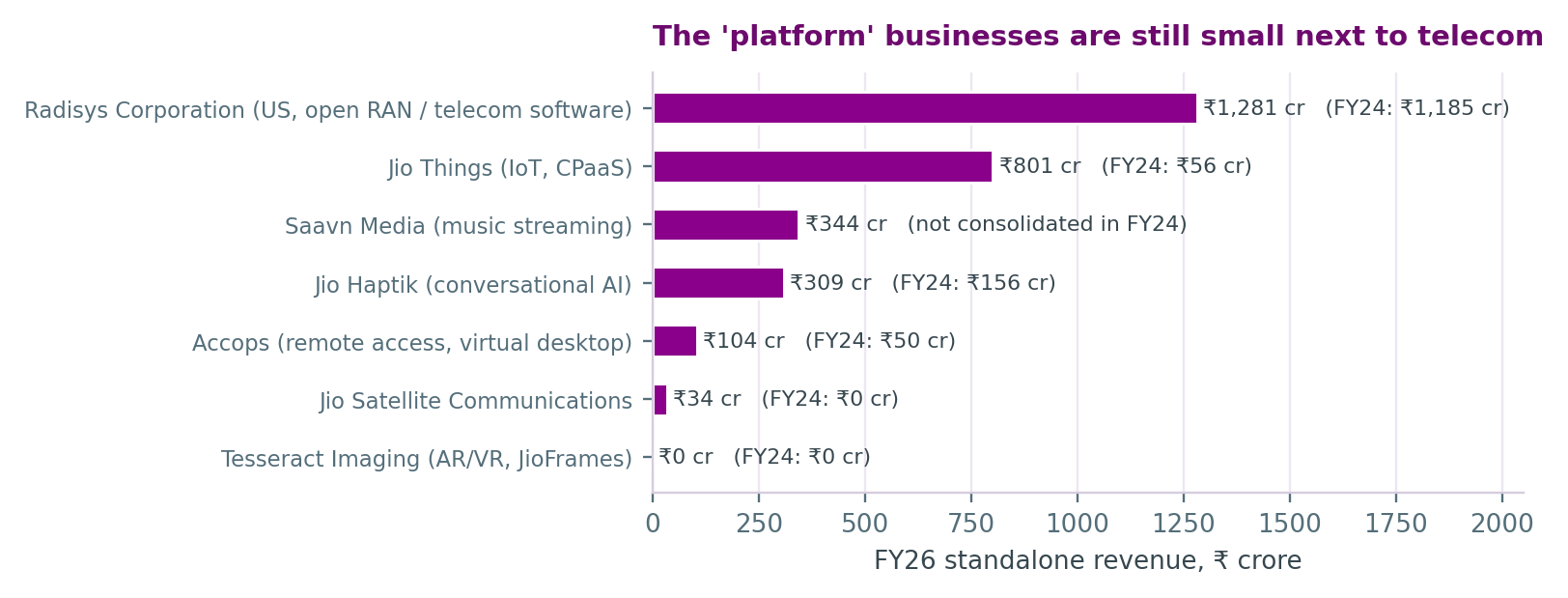
The future opportunities fall into two groups. Tariffs, home broadband and enterprise/IoT are near term, stay inside JPL and need little new capital. These are what a JPL shareholder actually owns. AI, satellite, 6G and overseas sales are longer dated, capital-heavy or, in AI's case, owned largely by the parent. They make Jio strategically important. They do not yet make it more valuable per share, and two of them (satellite and 6G) could take back some of the free cash flow the bull case relies on. That is why we value the near-term levers and treat the rest as optional upside.
We use the peer set named in the RHP. Airtel is the anchor because it is profitable and has positive net worth. Vodafone Idea is a cross-check only. Peer share prices are back-calculated from the RHP's P/E ratios: Airtel ₹1,806 (40.71x × ₹44.37) and Vodafone Idea ₹12.81 (3.99x × ₹3.21), both NSE closing prices on 13 October 2026.
| FY26 basis | Jio @ ₹1,065 | Jio @ ₹1,119 | Bharti Airtel | Vodafone Idea |
|---|---|---|---|---|
| Market cap | 9,80,762 | 10,30,491 | 11,00,832 | 1,38,765 |
| Net debt incl. spectrum dues & leases | 97,466 | 96,008 | 1,64,789 | 1,88,879 |
| Minority interest | 1,097 | 1,097 | 46,907 (book) – 2,90,165† | — |
| Enterprise value | 10,79,325 | 11,27,595 | 13,12,527 – 15,55,785 | 3,27,644 |
| EV / EBITDA (FY26) | 14.2x | 14.8x | 10.8x – 12.8x | 17.2x |
| EV / EBITDA (Q1 FY27 annualised) | 12.9x | 13.5x | 9.8x – 11.6x | 16.3x |
| EV / EBIT (FY26) | 22.0x | 23.0x | 19.3x – 22.8x | n.m. (EBIT loss) |
| P/E (FY26 diluted EPS) | 32.6x‡ | 34.3x‡ | 40.71x | 3.99x (n.m.) |
| P/B | 2.65x | 2.77x | 7.38x | negative net worth |
| Return on net worth | 9.42% | 9.42% | 20.32% | n.m. |
| (EBITDA − capex) / EV | 3.9% | 3.7% | 4.7% – 5.6% | n.a. |
Sources: Jio RHP; Bharti Airtel Integrated Annual Report FY26 (net debt incl. leases ₹16,47,888 mn; 6,094.39 mn shares; NCI ₹4,69,068 mn); Vodafone Idea Annual Report FY26 (10,834.30 crore shares; bank debt ₹4,001 cr; government dues ₹1,45,454 cr; cash and deposits ₹3,608 cr; leases ₹43,032 cr). †Book minority interest understates Airtel's listed stakes in Airtel Africa and Indus Towers. The higher figure values FY26 minority profit of ₹7,128 cr at Airtel's 40.7x P/E (our estimate). ‡Post-issue shares; on the RHP's pre-issue EPS the P/E is 31.7x–33.3x.
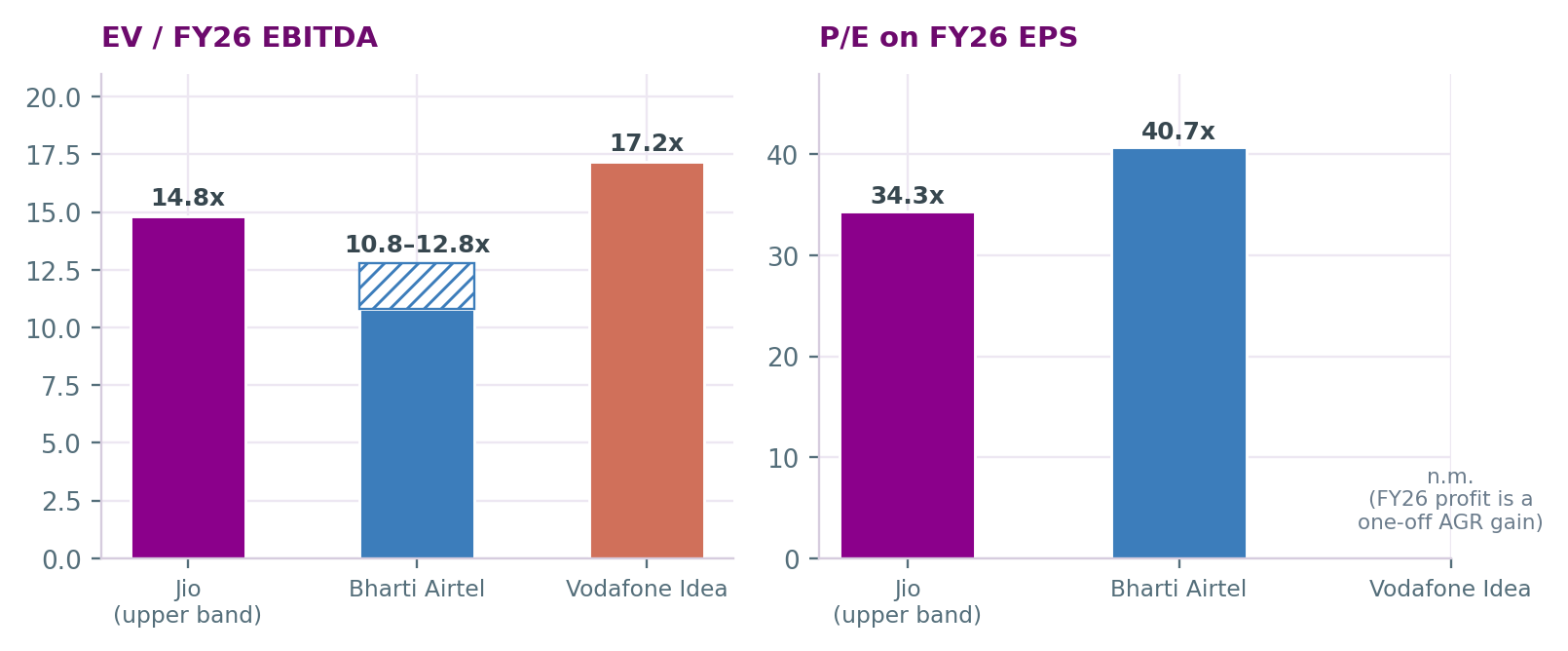
Why the methods disagree. Jio turns 39% of its EBITDA into shareholder profit, while Airtel turns 22%. Airtel has heavier depreciation (about 25% of revenue against Jio's 18.5%, which is itself helped by the 18-year asset life), pays ₹7,128 crore of profit to minority shareholders, and took an exceptional charge in FY26. P/E captures all of this and so flatters Jio. EV/EBITDA ignores it and so favours Airtel. EV/EBIT sits in between, and there Jio at ₹1,119 (23.0x) is almost level with Airtel (19.3x–22.8x).
Why Vodafone Idea is not used to set value. Its 3.99x P/E rests on a ₹58,607 crore one-time gain after its AGR dues were cut from ₹87,695 crore to ₹64,046 crore. Its net worth and EBIT are negative. Its 17.2x EV/EBITDA is high because of debt, not because the market values its business. We read it as a sign that the sector is not priced cheaply, nothing more.
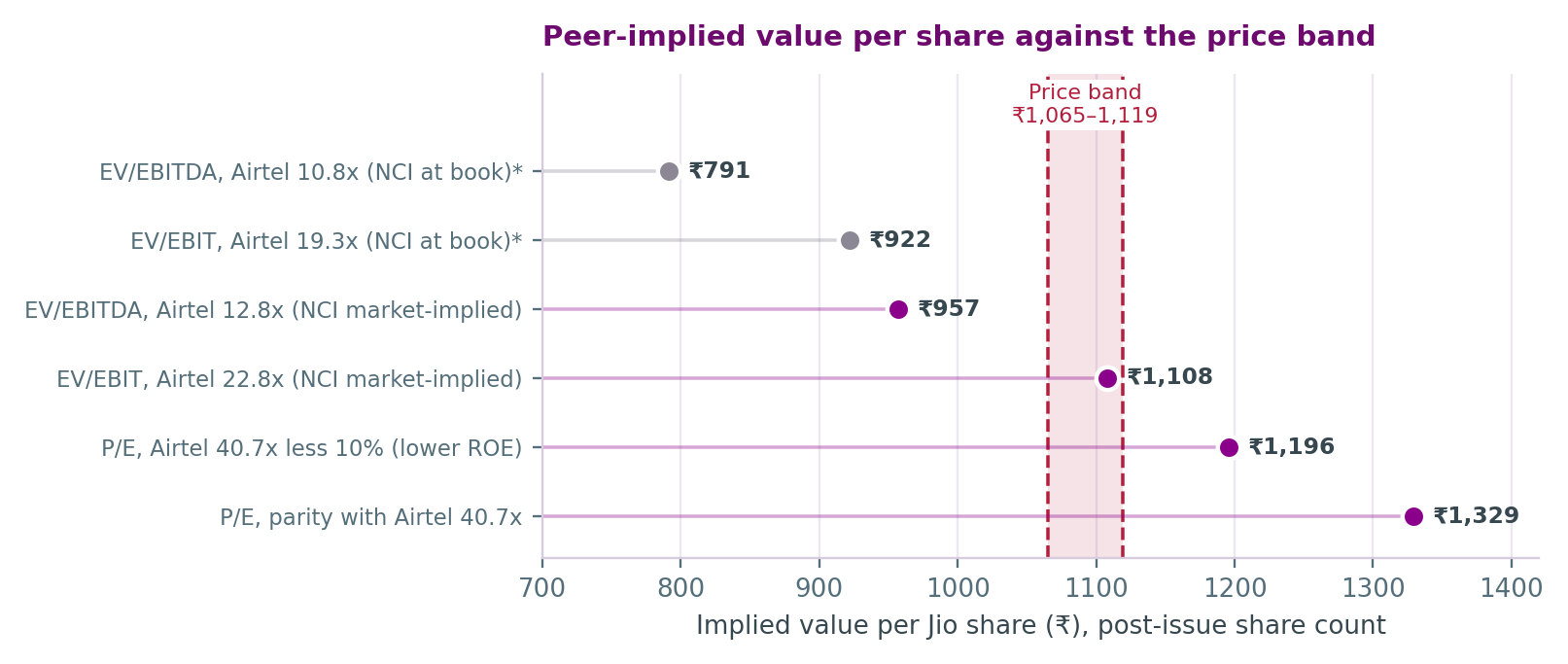
At Airtel's market-implied 12.8x, Jio's ₹11.28 lakh crore EV at the cap requires EBITDA of about ₹88,100 crore, 15.5% above FY26. Q1 FY27 annualised is ₹83,458 crore. The price band therefore pays for about one more year of mid-teens growth, which is demanding but achievable. It does not pay for a tariff hike, a satellite business or AI profits. It also does not allow for a second capex cycle. That balance is why we land on "fair".
| Scenario | What has to happen | Value / share | vs ₹1,119 |
|---|---|---|---|
| Bear | No tariff hike in FY27. ARPU flat. Satellite or 6G spending pushes capex back above 20% of revenue. Financial investors sell after the lock-in. Market values Jio on Airtel's EV/EBITDA. | ₹790–957 | −15% to −29% |
| Base | Current growth continues. Capex stays near FY26 levels. Valued on the mean of four Airtel-anchored methods. | ~₹1,150 | ~+3% |
| Bull | A ~15% industry tariff hike with about 60% sticking, home broadband scales as forecast, capex discipline holds. | ~₹1,310 | ~+17% |
Dart Consultants construction. Bull = base + ₹159 a share from the tariff illustration in 3.1, which may partly overlap with what is already in Airtel's price. No scenario gives value to AI, satellite or overseas sales.
The core telecom business is roughly fairly priced. The upside depends on events with a reasonable chance of happening within 12–24 months, mainly pricing, and the downside depends mainly on capital allocation. Investors are not being asked to pay for AI or satellites, which is good, because the structure gives JPL a limited share of the first and a large bill for the second. As a cross-check, Dart Consultants' Reliance Industries SOTP (30 September 2026) used a base-case Jio EV of US$120 billion, about ₹10.56 lakh crore. That is close to, and slightly below, the ₹11.28 lakh crore implied at the cap.
We group the RHP's 65 risk factors, plus what we found outside it, by how likely they are to hurt a shareholder.
Value going to the parent. Reliance Retail is the sole distributor of prepaid services (77.1% of revenue), and ₹1,12,935 crore of FY26 advance revenue came through it. RIL supplied 46.5% of Q1 FY27 cash capex. RIL owns the "Jio" trademark and can withdraw the licence if it loses control. The AI businesses, data centres and Meta JV sit at RIL. Group cable companies with 19.8 million subscribers compete for the same homes. Each arrangement may be fair on its own, but taken together they mean much of the value created around Jio's customers can be booked outside JPL.
A new spending cycle. The unfunded 1,600-satellite plan, 6G spectrum around 2029–30, and continued 5G densification could all pull capex back up. The bull case depends on capex discipline.
Tariffs and regulation. ARPU growth depends on price rises that the RHP admits may face customer or regulatory pushback. Inflation may delay them. Net-neutrality rules (risk factor 17) limit charging for 5G network slicing. The DPDP Act allows penalties of up to ₹250 crore, and AI and data rules are still changing.
Satellite and new technology. Satellite spectrum will be allotted administratively at about 5% of AGR, which lowers the entry cost for Starlink and OneWeb. The public dispute with Musk also adds political and reputational noise.
Earnings quality and returns. Return on net worth is 9.4% and return on capital employed 10.8%, about half of Airtel's. The useful-life change added ₹1,840.5 crore to FY26 PBT. Interest and depreciation on 5G assets will keep profit growth below EBITDA growth for a while.
Shares coming onto the market. Only 2.93% of the company floats at listing. About 14.7% of pre-issue shares belong to financial investors (PIF, KKR, Vista, Silver Lake, Mubadala, General Atlantic, ADIA, TPG, L Catterton), whose six-month lock-in ends around April 2027. Half of the anchor allocation is free to sell after 90 days.
Legal. There are 988 tax claims totalling ₹47,891 crore across the group (₹9,413 crore at Jio's subsidiaries). DoT's Supreme Court appeal over ₹1,389 crore of spectrum usage charges, and TRAI financial-disincentive orders, are pending.
The board has ten directors, five of them independent. Mukesh Ambani is non-executive Chairman and Akash Ambani is Managing Director until April 2031. JPL itself faces no criminal, regulatory or material civil cases, and the matters against RJIL are routine for a telecom operator. The fresh-issue structure and Crisil's monitoring of proceeds are positives. The governance question is the one raised throughout this report: how much of the value built around Jio's 533 million customers ends up in JPL, and how much in the rest of the Reliance group. The RHP describes the related-party arrangements as arm's length. We accept that, and still apply a 10% discount to Airtel's P/E for it.
Strip away the platform language and Jio is India's strongest telecom franchise, coming to market just as its capex falls and its cash flow rises. At ₹1,119 investors pay roughly fair value for that business. Airtel trades at a higher multiple on earnings and a lower one on EBITDA, and Jio's returns are lower. You get near-term options on tariffs and home broadband at no extra cost.
The bigger ideas are real but belong in perspective. AI will help Jio keep customers more than it lifts Jio's own profit, because the models, compute and enterprise platform belong mostly to its parent. Satellite is mainly a defence, and it could be expensive. 6G is a cost before it is an opportunity. The overseas stack has yet to win a customer. None of these is a reason to avoid the IPO, and none is a reason to pay above fair value. Investors who apply should do so as owners of a cash-generating telecom business with some upside, not as buyers of an AI company.
Apply at the cut-off and hold for the long term. Fair value is ₹957–1,329, with a central estimate near ₹1,150 and a bull case near ₹1,310 if tariffs rise. What would change our view: no tariff increase by mid-2027; capex back above about 20% of revenue, especially from an unfunded satellite build; new related-party arrangements that move AI or digital revenue outside JPL; or heavy selling when the lock-in ends. Press reports suggest a listing gain is possible, but that should not be the reason to apply. Do not apply with borrowed money. We do not use grey market premium (GMP) figures.
Primary documents: Jio Platforms RHP dated 14 October 2026 (restated financials FY24–Q1 FY27, Analysys Mason industry report, risk factors, subsidiaries, litigation); Bharti Airtel Integrated Annual Report FY26; Vodafone Idea Annual Report FY26. Secondary sources used for triangulation (accessed 16 October 2026):
Company figures come from the RHP. Peer figures come from the RHP's peer comparison and the two annual reports. Market cap, EV, multiples, tariff sensitivities, scenarios and fair values are Dart Consultants calculations using 920.90 crore post-issue shares. Peer prices are back-calculated from the RHP's 13 October 2026 P/E ratios. Outside information on satellite, AI, tariffs and 6G comes from press reports and has not been independently verified. Where reports conflict, as with Starlink's pricing, we say so. Issue terms can change, so investors should check the final Prospectus.
Dart Consultants is a market intelligence and technology service provider, not a SEBI-registered Investment Adviser or Research Analyst. This report is educational material only. It is not investment advice and not a recommendation to subscribe to, buy or sell any security. The APPLY rating is an educational device for summarising public information and one firm's own peer-relative valuation, not a regulated recommendation. Several figures in this report are Dart Consultants' own calculations or illustrations built from public information and were not disclosed by the company: the adjusted net debt, enterprise values, peer multiples, the market-implied value of Airtel's minority interests, the tariff sensitivity, the bear/base/bull scenarios and the fair-value range. They should be read as one firm's reasoning, not as certain. Statements about satellite, AI, 6G and tariff developments draw on third-party press reports that may be incomplete or may change. Where sources disagreed, we have shown the disagreement rather than choosing one number without saying so. IPO investments carry the risk of losing capital, and listing-day prices may differ materially from the issue price. Readers should verify any figure against the final Prospectus before relying on it. The analyst(s) preparing this report hold no position in Jio Platforms Ltd, Reliance Industries Ltd, Bharti Airtel Ltd or Vodafone Idea Ltd, have no banking, advisory or brokerage relationship with any of these companies or the book running lead managers to the issue, and have received no compensation from any of them.
| Recommendation | APPLY (long term) |
| Price band | ₹1,065 – ₹1,119 |
| Issue type | 100% fresh issue |
| Shares offered | 27.0 crore |
| Issue size | ₹28,755 – 30,213 cr |
| Lot size | 12 shares |
| Bid / issue period | 21 – 23 Oct 2026 |
| Listing (tentative) | 28 Oct 2026, NSE & BSE |
| Post-issue market cap | ₹10,30,491 cr |
| P/E (FY26, post-issue) | 34.3x |
| EV / EBITDA (FY26) | 14.8x |
| P/B (post-issue NAV) | 2.77x |
| Fair value (central) | ~₹1,150 |
| Bull case (with tariff hike) | ~₹1,310 |
| Reliance Industries | 66.43% → 64.48% |
| Meta (Jaadhu Holdings) | 9.98% → 9.69% |
| Google International | 7.73% → 7.50% |
| Other pre-IPO investors | 15.86% → 15.40% |
| IPO investors | — → 2.93% |
| FY25 | FY26 | Q1 FY27 | |
|---|---|---|---|
| Revenue | 1,28,218 | 1,46,885 | 39,173 |
| EBITDA | 64,170 | 76,255 | 20,865 |
| PAT | 26,109 | 30,049 | 7,764 |