This addendum updates our 30 September 2026 report on Reliance Industries Ltd using our Jio Platforms IPO review. Everything not mentioned here stands as published.
Our 30 September report valued Jio Platforms at a base-case enterprise value of US$120 billion. We took that from brokerage estimates because Jio had no market price. That has now changed. Jio's Red Herring Prospectus is dated 14 October, and the price band of ₹1,065–1,119 values the company at ₹10.30 lakh crore after the issue. The bidding opens on 21 October. Jio is RIL's single biggest SOTP input, so we have re-run that line using the IPO price and our own Jio review published today.
The net effect is small: our base-case SOTP moves to ₹1,588 a share from ₹1,609, and the target becomes ₹1,590 (from ₹1,610). Two things offset each other. In rupees, the IPO values Jio's business above our old assumption, which adds ₹35 a share. But working through the RHP showed that our original method never deducted Jio's own spectrum dues and leases. These are about ₹1.17 lakh crore, and correcting this costs ₹63 a share. Removing Jio's borrowings from RIL's net debt, so they are not counted twice, adds back ₹7.
The more interesting finding is what the IPO says about the rest of Reliance. At the cap price, RIL's 593.78 crore Jio shares are worth ₹6.64 lakh crore, about 40% of RIL's whole market value. That leaves ₹9.78 lakh crore for retail, O2C, oil and gas, New Energy, JioStar and the AI businesses combined. Our own base case values those at ₹14.83 lakh crore. The market is charging little more than the value of the Retail stake, and almost nothing for O2C, oil and gas, New Energy, JioStar and AI. We see that as an opportunity, not a warning sign. One caveat: after the 15 October rally, our bear case (₹1,208) now sits just below the share price, so the margin of safety is thinner than on 30 September. BUY maintained.
This is an addendum, not a new report. Everything in the original report that is not mentioned here still stands, including the investment rationale, governance assessment, SWOT and the reasons for caution. We changed three things:
What we did not change: the O2C, oil and gas, Retail, New Energy and JioStar inputs; RIL's net debt of ₹1,22,914 crore at 30 June 2026; the 1,352.2 crore share count; and the ₹88/US$ rate used for the dollar-based Retail and JioStar marks. RIL has not yet reported Q2 FY27 results. Historically RIL reports this quarter in mid to late October, and we will update the non-Jio segments after those results, not before.
Our Jio review (reference B) covers the IPO in detail. These are the points that matter for RIL:
| Item | Detail | Why it matters for RIL |
|---|---|---|
| Issue structure | Fresh issue of 27 crore shares, ₹30,213 cr at the cap. No OFS. | RIL sells nothing and receives no cash. Its stake is diluted from 66.43% to 64.48%. The cash goes into Jio to repay debt, which stays inside RIL's consolidated group. |
| Valuation at cap | Market cap ₹10.30 lakh cr. EV ₹11.28 lakh cr including spectrum dues and leases. 34.3x FY26 P/E, 14.8x FY26 EV/EBITDA. | The first market-based value for Jio since the 2020 private rounds at ₹488–549 a share. |
| Our view of the price | Fair value ₹957–1,329, central ~₹1,150, bull ~₹1,310 with a tariff hike. | The IPO price is close to fair. We take the market price as our base, without adding our own premium. |
| RIL shareholder quota | Up to ₹2,500 cr reserved for eligible RIL shareholders, who can also bid as retail or NII. | A direct, if modest, benefit to RIL holders: a better chance of allotment. |
| AI ownership | Reliance Intelligence (100% RIL), REIL (70% RIL, 30% Meta) and the Jamnagar AI data centres all sit outside Jio. | AI economics go to RIL shareholders at 100% (70% for REIL), not at Jio's 64.48%. See section 5. |
| Related parties | Reliance Retail is Jio's sole prepaid distributor (77.1% of Jio revenue). RIL supplied 46.5% of Jio's Q1 FY27 cash capex. RIL owns the "Jio" brand. | Value moving between Jio and RIL's other subsidiaries mostly stays within RIL's SOTP. Minority investors in Jio will watch these flows more closely after listing. |
Source: Jio Platforms RHP dated 14 October 2026; price band per company announcement (14 October 2026); Dart Consultants Jio review (16 October 2026).
In the original report, Jio was entered as 66.43% of a brokerage-sourced enterprise value. We then deducted RIL's reported consolidated net debt of ₹1,22,914 crore. Reading Jio's RHP made a problem with this clear. Jio's balance sheet carries ₹1,04,514 crore of deferred spectrum payments and ₹12,168 crore of lease liabilities on top of its borrowings. RIL's reported net debt is outstanding debt (₹3,69,705 crore) less cash (₹2,46,791 crore). We understand it to cover borrowings, not spectrum dues or leases. If so, our original method treated Jio as an enterprise but never took off its spectrum obligations. That overstated Jio's contribution.
The IPO gives a cleaner route. Jio's share price is an equity value: the market has already deducted Jio's borrowings, spectrum dues and leases. So we now value RIL's 593.78 crore Jio shares at that price. To avoid counting Jio's borrowings twice, we take Jio's own net borrowings (₹9,539 crore at 30 June 2026, per the RHP) out of RIL's consolidated net debt. That leaves ₹1,13,375 crore of net debt against the rest of the group.
We could not confirm from the sources available whether RIL's reported "outstanding debt" includes Jio's deferred spectrum payments. We have assumed it does not, which is the conservative choice. If it does include them, the original method had already deducted those dues, and the correct adjustment would release a further ₹1,16,682 crore from net debt. In that case the base case would rise by about ₹86 a share, to roughly ₹1,675. We will confirm this against RIL's FY26 annual report and the Q2 FY27 disclosures.
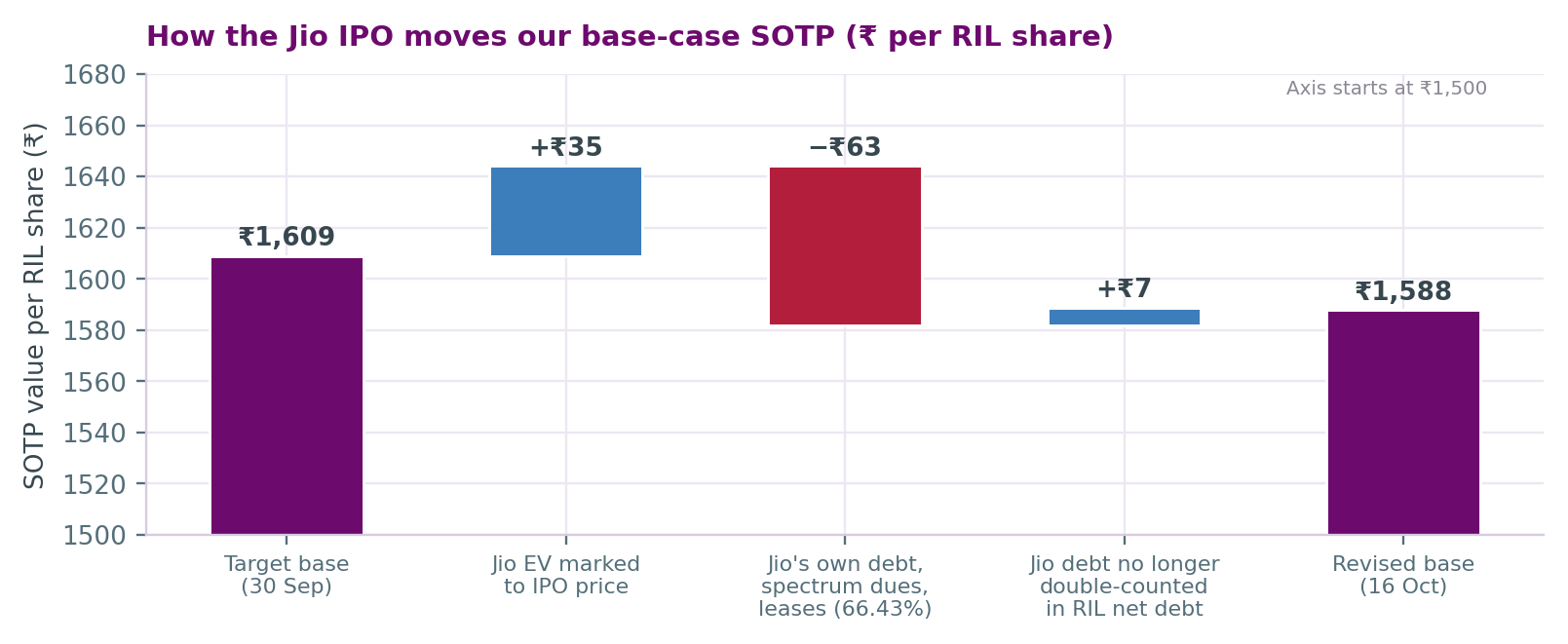
| Base-case bridge | ₹ crore | ₹ per RIL share |
|---|---|---|
| Jio line in the original report (66.43% × ₹10,56,000 cr EV) | 7,01,501 | 518.8 |
| (a) Mark Jio's EV to the IPO cap: ₹11,27,596 cr vs ₹10,56,000 cr, at 66.43% | +47,561 | +35.2 |
| (b) Deduct Jio's own net debt, spectrum dues, leases and minority interest (₹1,27,318 cr at 66.43%) | −84,577 | −62.5 |
| (c) Remove Jio's net borrowings from RIL's consolidated net debt | +9,539 | +7.1 |
| Effective new Jio contribution (= RIL's Jio shares at ₹1,119, plus (c)) | 6,73,983 | 498.4 |
| Change in base-case SOTP | −27,517 | −20.4 |
Rounding differences of under ₹50 crore. The fresh issue does not change value: new shares are issued at the same price that values the existing ones, and the cash goes into Jio. The fall in RIL's stake from 66.43% to 64.48% is offset by the ₹30,213 crore of new cash Jio receives.
A note on currency. Our original report converted dollar estimates at ₹88/US$. Press reports describe the IPO as valuing Jio at about US$107–108 billion, which implies about ₹95–96 to the dollar. The original Jio base of US$120 billion therefore looks generous in dollar terms but conservative in rupees. Using the rupee IPO price removes the currency question for Jio. We have deliberately not converted Retail's dollar marks at today's rate. Those marks were set when the rupee was near ₹88, and re-converting them would only add currency movement, not new information about the business.
| ₹ crore | Bear | Base | Bull |
|---|---|---|---|
| O2C (100%), unchanged | 3,93,549 | 4,54,095 | 5,14,641 |
| Oil & Gas (100%), unchanged | 76,200 | 85,725 | 95,250 |
| Reliance Retail (83.56% of EV), unchanged | 6,61,795 | 8,89,762 | 10,29,459 |
| New Energy (100%), unchanged | 0 | 1,20,000 | 1,80,000 |
| JioStar (63.16% of EV), unchanged | 47,244 | 47,244 | 55,581 |
| Non-Jio businesses, RIL-attributable EV* | 11,78,988 | 15,96,826 | 18,75,191 |
| Less: RIL net debt excluding Jio (₹1,22,914 − ₹9,539) | (1,13,375) | (1,13,375) | (1,13,375) |
| Equity value of non-Jio businesses | 10,65,613 | 14,83,451 | 17,61,816 |
| Jio share price used (₹) | 957 | 1,119 | 1,310 |
| Plus: RIL's 593.78 crore Jio shares at that price (new) | 5,68,251 | 6,64,444 | 7,77,857 |
| Equity value attributable to RIL shareholders | 16,33,864 | 21,47,895 | 25,39,673 |
| ÷ Shares outstanding (crore, unchanged) | 1,352.2 | 1,352.2 | 1,352.2 |
| SOTP value per share (₹) | 1,208 | 1,588 | 1,878 |
| Previous (30 Sep) | 1,214 | 1,609 | 1,918 |
| Upside vs CMP ₹1,215 | −0.6% | +30.7% | +54.6% |
*Subtotals are carried from the original report's totals less its Jio line, so they reconcile to the 30 September figures exactly; individual rows may not add up because of rounding in the original. Segment methodologies, multiples and sources are unchanged; see the footnotes in section 8 of the original report. Jio prices: bear = top of the bear range in our Jio review; base = IPO cap price; bull = bull case in our Jio review.
Once Jio has a share price, a simple test becomes possible. Take RIL's market value, subtract its Jio stake at the IPO price, and see what is left. At ₹1,215, RIL's market cap is about ₹16.43 lakh crore. RIL's Jio stake at ₹1,119 is worth ₹6.64 lakh crore. The remaining ₹9.78 lakh crore is what the market is paying for Reliance Retail, O2C, oil and gas, New Energy, JioStar, Reliance Intelligence and everything else, net of debt.
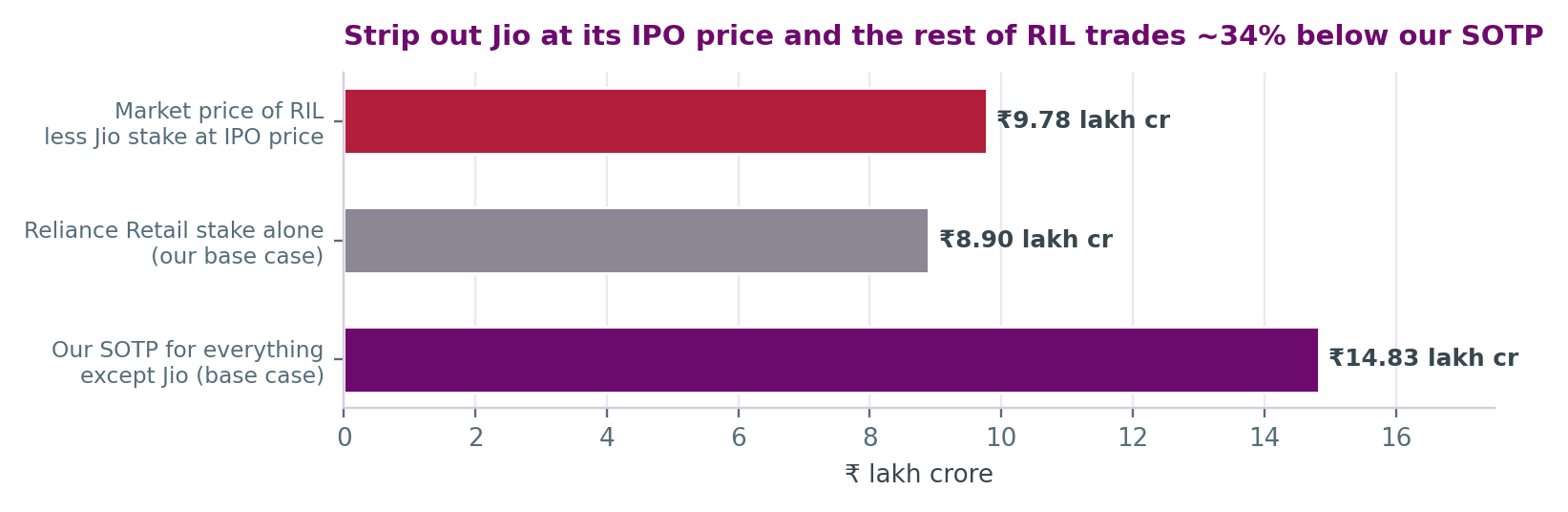
Our base case values those non-Jio businesses at ₹14.83 lakh crore after debt, so the stub trades about 34% below our estimate. Put another way, the market is paying for the Retail stake (₹8.90 lakh crore in our base case) and a little more. It gives almost nothing for O2C, which earned ₹60,546 crore of EBITDA in FY26. Even if we use our bear case for every non-Jio segment (₹10.66 lakh crore), the stub is still about 8% cheaper.
Some discount is normal for a conglomerate, and the original report said so. Investors can now own Jio directly, and some may sell RIL to do it, which could keep the discount wide for a while. JPMorgan named a widening holding-company discount as a downside risk in its 3 September note. But a 34% discount on businesses that include India's largest refiner and largest retailer is wide. The likely triggers to narrow it are already known: Jio trading at or above its IPO price, Q2 FY27 results, and any market-based valuation of Reliance Retail.
Writing the Jio review made us look at RIL from Jio's side. Four findings change how we see the RIL case.
The original report did not value Reliance's AI businesses, and neither does this addendum. The Jio review established who owns them. The Google Gemini AI Pro offer runs through Reliance Intelligence, a wholly owned RIL subsidiary. The Meta enterprise AI venture (REIL) is 70% Reliance Intelligence. The Jamnagar AI data centre, with 120 MW targeted by end-2026, is being built by Reliance Intelligence. The RHP says Jio "relies on the Promoter" for data centres. For an investor who wants exposure to Reliance's AI build-out, RIL is the more direct holding: it captures that value at 100% (70% for REIL), while Jio's 64.48% interest mostly gives distribution and retention benefits. This is optional upside we do not value, and it strengthens the case for owning RIL over Jio for that theme.
Reliance Retail is Jio's only prepaid distributor and handled ₹1,12,935 crore of Jio's FY26 advance revenue. RIL supplied 46.5% of Jio's cash capex in Q1 FY27. The brand is owned by RIL. For Jio's minority shareholders these are governance questions. For RIL shareholders they largely net out, because RIL owns 83.56% of Retail and 64.48% of Jio. Listing will add scrutiny, which we think is healthy for both companies.
Jio's proposed 1,600-satellite constellation has no disclosed cost or funding, and 6G will bring a new spectrum and network cycle around 2029–30. Whether these are funded inside Jio, by RIL, or with partners will affect RIL's own capex and net debt. This adds to the New Energy capex already flagged in the original report. We note it as a risk to RIL's "lower capex intensity" narrative from FY28 onward.
From 28 October, Jio's share price will directly mark a large part of RIL's value. Each ₹100 move in Jio's price moves our RIL SOTP by about ₹44 a share. That makes RIL more transparent, but also more volatile around Jio-specific news such as tariff moves, the end of Jio's six-month lock-in around April 2027, and satellite policy.
Two variables now matter most for RIL's target: where Jio trades, and whether the market applies a holding-company discount to RIL's Jio stake. The grid below shows base-case RIL value per share, with all non-Jio inputs held at base.
| Jio share price (₹) | No holdco discount | 10% discount on Jio stake | 20% discount on Jio stake |
|---|---|---|---|
| 957 (Jio review, top of bear range) | 1,517 | 1,475 | 1,433 |
| 1,065 (IPO floor) | 1,565 | 1,518 | 1,471 |
| 1,119 (IPO cap, our base) | 1,588 | 1,539 | 1,490 |
| 1,150 (Jio review central fair value) | 1,602 | 1,552 | 1,501 |
| 1,310 (Jio review bull case) | 1,672 | 1,615 | 1,557 |
Dart Consultants calculation. Every cell is at least 18% above the CMP of ₹1,215. The lowest value in the grid, ₹1,433, combines a Jio price at the top of our bear range with a 20% holding-company discount, and is still 18% above the current price.
Upgrade triggers: Jio lists and trades sustainably above ₹1,119. Q2 FY27 results confirm O2C and Retail momentum. An industry tariff increase (our Jio review estimates ₹106–212 a share of Jio value for a 15% hike, or about ₹47–93 a share of RIL). A market-based valuation event for Reliance Retail. Confirmation that RIL's reported debt already includes Jio's spectrum dues (worth about ₹86 a share).
Downgrade triggers: Jio trades below ₹957 for a sustained period. A disclosed decision to fund the satellite constellation from RIL's own balance sheet without a clear return case. A further retreat in the New Energy battery strategy beyond the Hithium-to-CATL change already described in the original report. Evidence that the holding-company discount is widening rather than narrowing after Jio lists.
The Jio IPO answers the question the original report described as the single biggest swing factor: what Jio is worth. The answer is close to our previous assumption. In rupees it is slightly higher, and after correcting our method for Jio's spectrum dues it is slightly lower. The target moves by ₹20. What has changed is the confidence behind the number. About 31% of our base-case SOTP now rests on a price set by investors bidding real money, not on a range of brokerage estimates from US$92 billion to US$190 billion. The rest of Reliance is priced at a 34% discount to our estimate, even before any value for AI. Our BUY call is unchanged.
The non-Jio inputs, RIL net debt (30 June 2026, RIL media release of 17 July 2026) and share count come from the original report and have not been re-sourced. Jio inputs come from the Jio Platforms RHP dated 14 October 2026 and Dart Consultants' Jio review of 16 October 2026: RIL's 593,78,41,645 shares, Jio net borrowings of ₹9,539 crore, deferred spectrum payments of ₹1,04,514 crore, leases of ₹12,168 crore and minority interest of ₹1,097 crore. The price band comes from the company's 14 October 2026 announcement as reported in the press. RIL's CMP of ₹1,215 is the 15 October 2026 close as shown on screener.in before the 16 October open; press reports put the day's move at about +3%. The reported dollar value of the IPO (US$107–108 billion) comes from press reports, including Reuters via The Edge and INDmoney. All SOTP values, the bridge, the stub analysis and the sensitivities are Dart Consultants calculations.
Dart Consultants is a market intelligence and technology service provider, not a SEBI-registered Investment Adviser or Research Analyst. This addendum is educational material only. It is not investment advice and not a recommendation to buy or sell any stock or to subscribe to any IPO. The BUY rating and target price are educational devices for summarising public information and one firm's own Sum-of-the-Parts construction, not regulated recommendations. This addendum updates only the inputs described in it. It relies on the original report of 30 September 2026 for every other input, and those inputs include estimates from secondary and brokerage sources rather than observed market prices. The Jio valuation now rests on an IPO price band that has not yet been tested by listing, and Jio's traded price may differ materially from it. Our treatment of RIL's net debt rests on an assumption, stated in section 3, that we could not fully verify. Readers should treat the target as one firm's reasoning, not as certain, and should verify any figure before relying on it. The analyst(s) preparing this addendum hold no position in Reliance Industries Limited or Jio Platforms Limited, have no banking, advisory or brokerage relationship with either company or with the lead managers to the Jio IPO, and have received no compensation from any of them.
| 12-month target | ₹1,590 |
| Previous target (30 Sep) | ₹1,610 |
| CMP (15 Oct 2026) | ₹1,215 |
| Implied upside | +30.9% |
| Rating | BUY (maintained) |
| 30 Sep | 16 Oct | Chg | |
|---|---|---|---|
| Bear | 1,214 | 1,208 | −6 |
| Base | 1,609 | 1,588 | −21 |
| Bull | 1,918 | 1,878 | −40 |
| Basis (30 Sep) | Brokerage EV, $120bn |
| Basis (16 Oct) | IPO price, ₹1,119 |
| RIL's Jio shares | 593.78 crore |
| RIL stake pre / post | 66.43% / 64.48% |
| Value of RIL's stake | ₹6,64,444 cr |
| Share of RIL market cap | ~40% |
| Recommendation | APPLY (long term) |
| Fair value range | ₹957 – 1,329 |
| Central / bull | ~₹1,150 / ~₹1,310 |