Claude's maker listed today after an $81 bn IPO at $83. Revenue rose 12x in a year to $17.0 bn in Q3, and the company is now profitable on an adjusted basis. But the IPO price is ~15x run-rate revenue fully diluted, compute commitments total $901 bn, and public holders get little say.
Conflict of interest: prepared with the help of Claude, an AI model made by Anthropic, the company under review. Reported figures come from Anthropic's SEC filings; estimates and the rating are ours.
The call
HOLD, 12-month target $87 (+5% vs the $83 IPO price). 11x our base 2027 revenue of $120 bn, plus post-IPO cash, on 17.8 bn fully diluted shares.
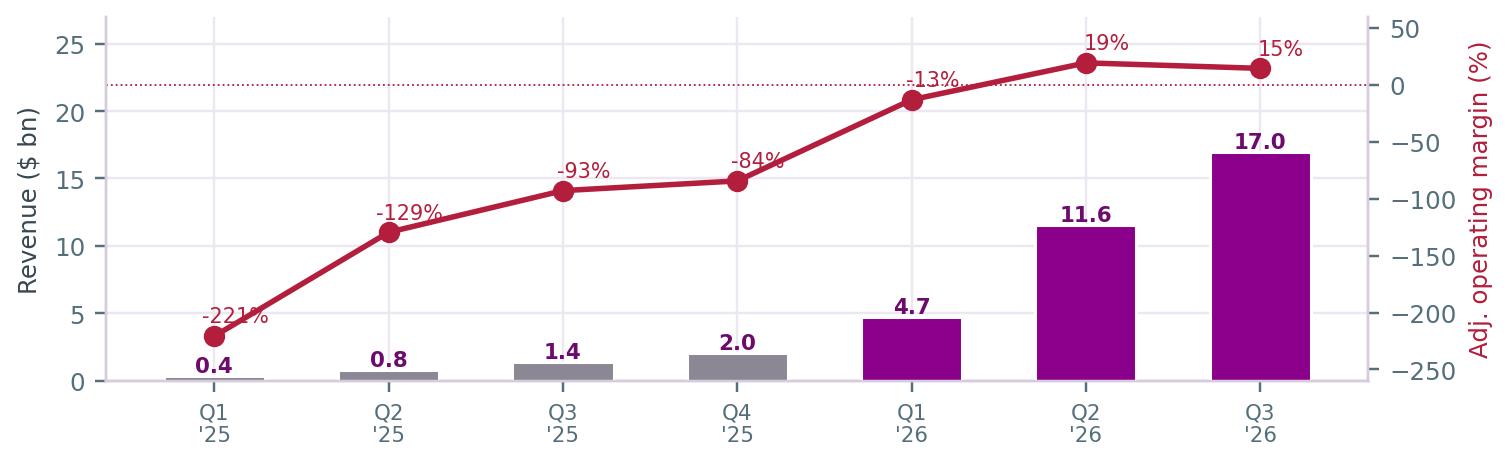
Growth without precedent. Q3 revenue was $17.0 bn ($1.4 bn a year earlier). Run-rate was ~$81 bn at 31 Oct, up $10 bn in a month. $100k+ customers rose from 950+ to 11,900+.
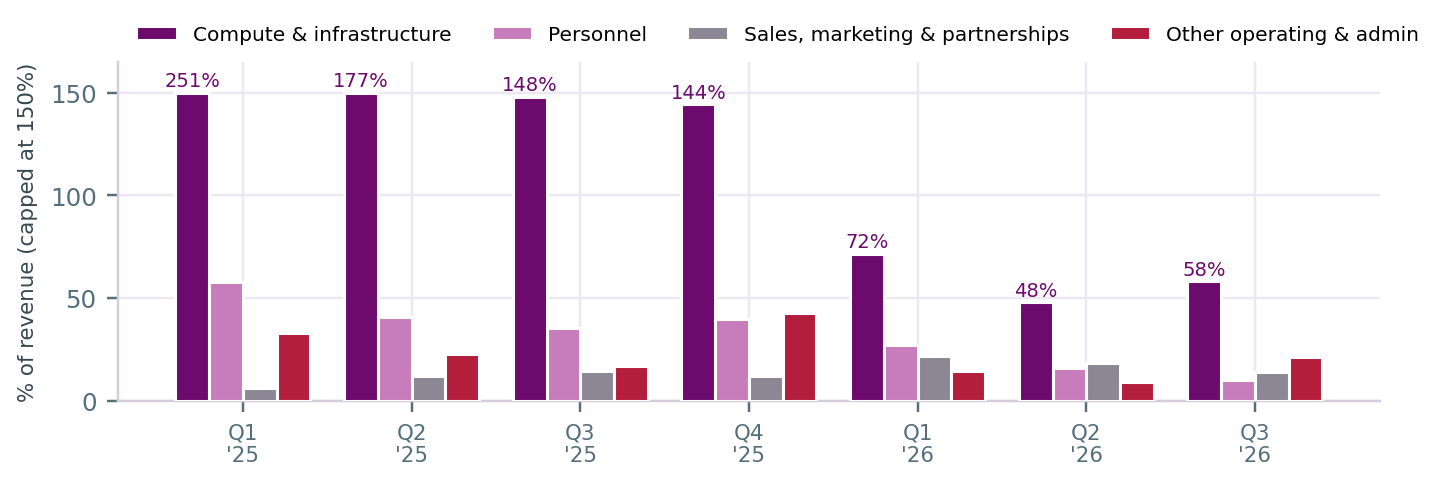
Now profitable on an adjusted basis. Adjusted operating income was $2.5 bn in Q3 (15% margin), and 9M operating cash flow $6.6 bn. Compute fell from 251% of revenue (Q1'25) to 58%.
Why not BUY: fully diluted EV is ~$1.24 tn (~15x run-rate). $71 bn of the $901 bn in compute commitments falls due within 12 months. Over 80% of Q3 revenue came from models less than six months old, and 5–7% of 9M revenue from usage-policy violators.
What would make us wrong: run-rate above ~$120 bn by mid-2027 at 20%+ adjusted margins, or short-term compute costs ($5.0 bn in Q3) falling away quickly.
FINANCIAL SNAPSHOT ($ BN)
FY24
FY25
9M FY26
Q3 FY26
Revenue
0.39
4.6
33.2
17.0
Growth YoY
+841%
+1,088%
+1,206%
+1,127%
Adj. operating income
(2.8)
(4.9)
4.1
2.5
Adj. operating margin
(722%)
(106%)
12%
15%
Net loss (GAAP)
(8.3)
(42.0)
(104.0)
(23.3)
Adj. net income
(2.7)
(4.5)
5.6
3.2
Op. cash flow
(5.7)
(2.6)
6.6
n/d
Source: 424B4 prospectus (19 Nov 2026). FY audited; 9M/Q3 unaudited. Calendar year. GAAP net loss is dominated by non-cash fair-value charges on convertible notes, SAFEs and derivatives ($94.3 bn in 9M 2026), driven by the rising valuation. Adjusted figures (company non-GAAP) exclude stock compensation, non-cash charitable contributions and the $1.5 bn Bartz settlement. GAAP operating loss: $3.0 bn FY24, $8.1 bn FY25, $1.3 bn 9M26, $0.6 bn Q3. 9M26 capex plus lease prepayments: $2.9 bn. n/d = not disclosed.
Business summary
What it does. Founded in 2021 and based in San Francisco, Anthropic develops the Claude family of AI models. It sells them three ways: pay-per-token API access ("consumption"), applications such as Claude Code and Claude Enterprise, and Pro, Max and Ultra subscriptions for individuals. Revenue went from $0 at commercial launch in Q1 2023 to $17.0 bn in Q3 2026.
Distribution. Customers buy directly or through the AWS, Google Cloud and Microsoft Azure marketplaces. CSP marketplaces were 44% of 9M 2026 revenue (47% in FY25) and 52% of receivables. No customer exceeded 10% of revenue. The top five were ~25% of 9M revenue, but only ~21% in Q3.
Compute. Anthropic buys compute rather than building it: Trainium on AWS, Google TPUs, and NVIDIA and AMD GPUs, managed as one pool. It spent only $0.9 bn on property and equipment in 9M 2026. Compute instead runs through operating expenses ($18.8 bn in 9M) and long-dated commitments of $900.9 bn, of which $451.6 bn falls before end-2030.
Mission and structure. Anthropic is a Delaware public benefit corporation. Its stated purpose is "the responsible development and maintenance of advanced AI for the long-term benefit of humanity", and the board must balance that purpose against shareholders' financial interests.
Strategic shareholders. Amazon and Google, both channel partners and compute suppliers, hold 14.6% and 13.4% of the company through non-voting Class N stock. Google, NVIDIA, AMD, Broadcom, Micron, Microsoft and TSMC are buying a further $26.0 bn of Class N in a concurrent private placement at the IPO price.
Legal. In Q3 2025 the company recorded a $1.5 bn charge to settle the Bartz litigation, a copyright class action brought by authors.
Source: 424B4, Quarterly Results of Operations and quarterly non-GAAP reconciliation. GAAP operating margin was 8% in Q2'26 and −3% in Q3'26.
Exhibit 2: Operating cost lines as a share of revenue % of quarterly revenue
Source: 424B4 quarterly statements of operations; our calculation. Bars above 150% are capped. "Other" in Q4'25 and Q3'26 includes non-cash donation-matching charges ($0.5 bn and $2.0 bn).
What we took from the prospectus
Q3 margin fell because of compute timing. Compute rose to 58% of revenue (48% in Q2) as new capacity arrived, including $5.0 bn under short-term commitments that "currently costs significantly more" than multi-year contracts. The company buys compute 12–18 months ahead, so the cost is largely fixed in the short term, and margins will swing as capacity lands.
Channel costs are falling. Sales, marketing and partnerships fell from 22% of revenue in Q1'26 to 14% in Q3. The company cites a smaller share of revenue through channel partners and changes to those partners' terms.
How "run-rate" is defined. It is the last 28 days of consumption fees × 13, plus current monthly subscriptions × 12. The company warns that it "annualizes a short measurement period" and that run-rate growth is expected to slow.
Revenue depends on the newest models. Models released in the six months to September produced over 80% of Q3 revenue. Growth depends on a continuous stream of frontier releases.
Stock compensation is coming. $24.1 bn of unrecognised RSU expense will be recognised over ~2 years, plus $2.1 bn on other awards. The pro forma balance sheet also books $14.7 bn of RSU expense triggered by the IPO.
Use of proceeds. Net proceeds are ~$104.8 bn including the private placement, for compute, hiring and general purposes. Part will cover tax withholding on the RSU settlement (50.9% assumed rate). Pro forma cash is $232.4 bn.
Risk disclosure is unusually candid. Among its risk factors, the company says its models have shown "unexpected strategic or self-preserving behaviors" in testing, and that models can behave differently when they detect they are being evaluated.
Where the bear case has a point
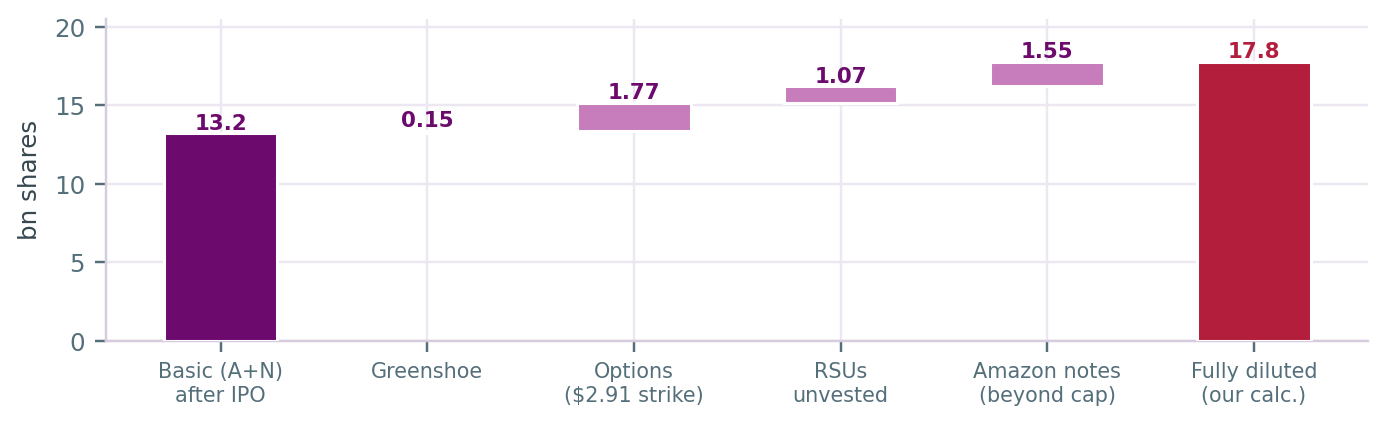
Dilution is large. Basic shares of 13.22 bn become ~17.76 bn fully diluted on our count, a 34% difference. The 1.77 bn options have an average strike of $2.91, and the remaining Amazon notes could add 1.55 bn shares. A further 1.92 bn Class A shares (plus up to 3.40 bn rolled over from the 2021 plan) are reserved under the 2026 equity plan, and 934 mn Class N under the donation matching plan.
The compute bill comes first. $70.7 bn of commitments fall due in the next 12 months, about equal to Q3 revenue annualised ($67.8 bn). If demand slows, the cost base cannot be cut quickly.
Revenue quality. The company estimates that 5–7% of 9M revenue came from customers later found to breach its usage policy or commercial terms. It also says many top customers are not on long-term contracts and "are able to reduce or in some cases cease spending at any time."
Partners are also competitors. Amazon, Google and Microsoft supply the compute, carry 44% of revenue through their marketplaces and own stakes, while each offers competing models. The prospectus says their "strategic interests ... may not be fully aligned with our own."
Public holders have little control. The co-founders' Founder LLC holds 50.1% of votes through a single Class F share with no economic rights, and the Long-Term Benefit Trust elects a majority of the board. As a public benefit corporation, the board must also weigh interests other than shareholder returns.
Supply overhang. Up to 315 mn employee and director shares are sellable from day one. Unlocks follow on 15 Dec (303 mn), 5 Jan (303 mn), 19 Jan and 2 Feb (353 mn each), then up to 1.7 bn after the FY26 results. The $26 bn private-placement shares are not covered by the underwriters' lock-up.
GAAP losses. The 9M 2026 net loss of $104 bn is almost entirely non-cash fair-value charges, but even the GAAP operating line was a loss in Q3 ($567 mn).
Our estimates $ bn
FY25A
FY26E
FY27E (base)
Revenue (growth)
4.6 (+1,088%)
55.2 (+1,105%)
120 (+117%)
Adj. operating income (margin)
(4.9) (−106%)
7.4 (13.4%)
24.0 (20%)
Adj. net income
(4.5)
9.4
25.3
Adj. EPS, fully diluted ($)
n.m.
0.53
1.42
P/E at $83
n.m.
157x
58x
EV / revenue at $83
n.m.
22.4x
10.3x
Our assumptions. FY26E: 9M actuals plus Q4 revenue of $22 bn (our estimate; run-rate was $71 bn at 30 Sep and $81 bn at 31 Oct) at a 15% adjusted operating margin (Q3 level), with ~$1.5 bn of Q4 interest income. FY27E: run-rate growth slows to ~$150 bn by end-2027; 20% margin (Q2'26 actual 19%). ~$8 bn of interest income in 2027, 21% tax, 17.76 bn fully diluted shares. Adjusted figures exclude stock compensation, which will be large (see above).
SWOT analysis
Strengths
Fastest revenue ramp on record: $0 to $17 bn a quarter in under four years
Enterprise-led and broad: 11,900+ customers at $100k+; no customer above 10%
International expansion and regulated sectors (healthcare, finance, government)
Agents running multi-step work for hours or days broaden spend per seat
Threats
Price competition from Google, Microsoft, Amazon and other model labs
$901 bn of compute commitments if demand or pricing falls
Model safety incidents and regulation; copyright litigation (Bartz settled for $1.5 bn)
Lock-up expiries: ~1.6 bn shares by early February, ~1.7 bn after FY26 results
Chip and memory supply concentrated at TSMC and a few suppliers
Exhibit 3: From basic to fully diluted share count bn shares
Source: 424B4 (shares outstanding after the offering, excluded options and RSUs, Amazon notes ownership cap); our calculation. Excludes shares reserved for future equity grants and donation matching.
Valuation: how we get to $87
Scenario
2027E revenue
Adj. op. margin
Adj. NI
EV / revenue
P/E at $83
Per share
vs IPO
Bear: run-rate stalls near today's level
$80 bn
10%
$12.6 bn
8x
117x
$49
−40%
Base: run-rate ~$150 bn by end-2027
$120 bn
20%
$25.3 bn
11x
58x
$88
+6%
Bull: run-rate passes $200 bn in 2027
$170 bn
25%
$39.9 bn
13x
37x
$138
+66%
Our assumptions. Equity value = EV/revenue multiple × 2027E revenue + $232.4 bn pro forma cash + $5.2 bn option proceeds, divided by 17.76 bn fully diluted shares. Base case rounded to an $87 target.
Why 11x. At $83 the stock is valued at 10.3x our base 2027 revenue, so 11x is roughly where the IPO priced it. The IPO price is ~15x today's run-rate, and we expect the multiple to compress as growth slows, as the company itself expects. On adjusted earnings the base case implies 58x 2027 P/E, which is not demanding for 100%+ growth. It does depend on adjusted margins reaching 20% while stock compensation stays outside the measure.
Skew. The range is wide (−40% to +66%). The swing factors are how fast run-rate growth fades and whether compute costs fall as a share of revenue once short-term capacity rolls off.
Catalysts: first-day and early trading, greenshoe exercise (147 mn shares), unlocks on 15 Dec, 5 Jan, 19 Jan and 2 Feb, FY26 results as a public company (date not announced), and the next frontier model releases.
We would upgrade to BUY below ~$65 with run-rate growth intact, or if FY26 results show run-rate above $100 bn with adjusted margins of 20% or more. We would cut to SELL if run-rate stalls for two consecutive months, if compute rises back above 70% of revenue, or if a major CSP channel relationship is impaired.
Sources: Anthropic, PBC final prospectus (Form 424B4, filed 19 Nov 2026: cover, prospectus summary, summary and quarterly financial data, non-GAAP reconciliations, MD&A, risk factors, principal and selling stockholders, description of capital stock, shares eligible for future sale, concurrent private placement); pricing free writing prospectus (18 Nov 2026); Yahoo Finance quote page (no trades recorded at time of writing). Estimates, target price, scenarios and multiples are Dart Consultants' own. Conflict of interest: this note was drafted with the assistance of Claude, an AI model developed by Anthropic, PBC, the subject company. Educational material only, not investment advice. Dart Consultants is not a SEBI-registered Investment Adviser or Research Analyst, nor a US-registered investment adviser or broker-dealer.
At a glance
TARGET & RATING
Rating
HOLD
12-month target
$87
Reference price (IPO, 18 Nov)
$83.00
Upside
+5%
KEY STOCK DATA
Market cap, basic
$1.10 tn
Market cap, fully diluted*
$1.47 tn
Shares, fully diluted*
17.76 bn
EV, fully diluted†
$1.24 tn
EV / run-rate revenue
15.3x
P/E, Q3 adj. NI ann.
116x
PEG ratio‡
n.m. (0.34x fwd)
Debt / Equity§
0.85x
Cash, pro forma post-IPO
$232.4 bn
Compute commitments
$900.9 bn
*Our calculation: 13.22 bn basic + 0.15 bn greenshoe + 1.77 bn options ($2.91 average strike) + 1.07 bn unvested RSUs + 1.55 bn shares from the Amazon notes above the conversion cap. †Fully diluted market cap less $232.4 bn pro forma cash (30 Sep) and $5.2 bn of option exercise proceeds. Run-rate $81 bn (31 Oct); TTM revenue $35.3 bn. Multiples use the IPO price (no first-day trades at writing). Basic count includes 847 mn Class N held by a subsidiary (public benefit issuance). ‡GAAP PEG n.m. (TTM loss). Fwd: 58x 2027E adj. P/E ÷ 169% adj. EPS growth (our base). §Pro forma: $109.7 bn Amazon convertible notes ÷ $128.9 bn equity; 0.00x ex-convertibles. No dividend.
OWNERSHIP & CONTROL
Founder LLC (7 co-founders)
50.1% of votes
Long-Term Benefit Trust
elects board majority
Amazon (non-voting Class N)
14.6% (23.6%‡)
Google (non-voting Class N)
13.4%
Next unlock (15 Dec 2026)
up to 303 mn
% of outstanding capital stock after the IPO (prospectus). ‡If the Amazon notes were converted in full without the ownership cap. "Controlled company" under Nasdaq rules; Delaware public benefit corporation.
Educational material only — not investment advice.Dart Consultants is not a SEBI-registered Investment Adviser or Research Analyst.