Starlink, the dominant launch business and xAI's AI cloud in one Musk-controlled company. Q3 revenue rose 161% and Q1 2027 is guided to $33–37 bn. But at $140 the market already pays ~22x our 2027 EBITDA, capex is more than twice EBITDA, and up to 798 mn shares unlock on 8 Dec.
The call
HOLD, 12-month target $135 (−4%). 22x our base 2027 Adjusted EBITDA of $85 bn, less the net debt we expect from the capex programme, on 12.6 bn economic shares.
The growth is real. Q3 2026 revenue was $14.6 bn (+161%), Adjusted EBITDA $8.8 bn (+306%) and GAAP net income $4.4 bn (a $1.1 bn loss a year ago). Backlog is $63 bn, two-thirds due within a year.
Starlink is the visible profit engine. Connectivity revenue grew 69% to $5.2 bn with $2.4 bn of operating income, on 13.6 mn consumer subscribers (7.2 mn a year ago).
AI is now the biggest segment. SI revenue rose from $0.8 bn to $7.6 bn, mostly from renting compute. One SI customer was 34.5% of group revenue, on contracts management calls short-term and spot-priced.
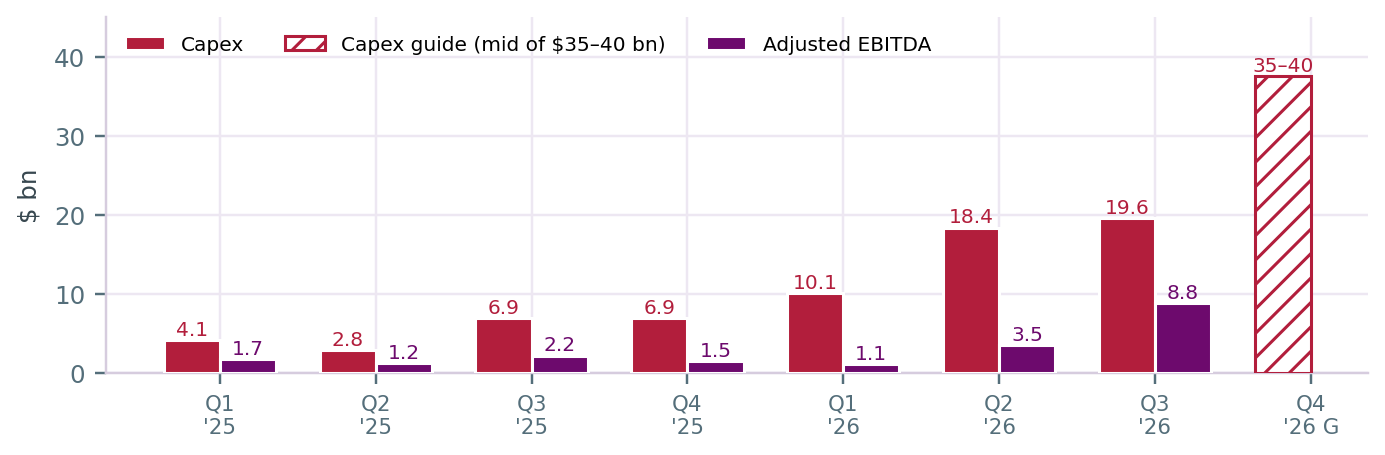
Why not BUY: 9M capex was $48 bn against $13 bn of operating cash flow, Q4 capex is guided at $35–40 bn, and Musk is aiming for 10+ GW of new compute in 2027. The price already reflects the guided ramp; more upside needs belief in the $500 bn–$1 tn end-2027 "ARR" ambition.
What would make us wrong: compute pricing holding above $50/watt at scale, Q1 2027 at the top of guidance with Q2-level margins, or Starship full reuse sharply cutting the cost of V3 satellite deployment.
FINANCIAL SNAPSHOT ($ BN)
FY24
FY25
9M FY26
Q3 FY26
Revenue
14.0
18.7
27.1
14.6
Growth YoY
+34.9%
+33.2%
+97.5%
+161%
Adjusted EBITDA
5.4
6.6
13.5
8.8
Adj. EBITDA margin
38.2%
35.3%
49.8%
60.4%
Op. income (loss)
0.5
(2.6)
0.7
2.8
Net income (loss)
0.8
(4.9)
(0.4)
4.4
Op. cash flow
5.8
6.8
13.1
n/d
Capex
11.2
20.7
48.1
19.6
OCF less capex
(5.4)
(14.0)
(35.0)
n/d
FY24/FY25: audited figures in the IPO prospectus (424B4, 12 Jun 2026), restated to include xAI and X under common-control accounting. 9M/Q3 FY26: Q3 2026 earnings release and 10-Q. Calendar fiscal year. Adjusted EBITDA is the company's non-GAAP measure; it excludes share-based compensation ($2.4 bn in Q3 alone). n/d = not disclosed for the quarter.
Business summary
What it does. Founded in 2002 and based in Starbase, Texas. SpaceX reports three segments: Space (Falcon 9, Falcon Heavy and Dragon launches, plus Starship development), Connectivity (Starlink broadband, Starlink Mobile direct-to-cell and Starshield for governments), and SI (xAI's Grok models, the X social network, cloud compute rented to third parties and, since August, Cursor).
How it got here. xAI (which had absorbed X in March 2025) merged into SpaceX on 2 February 2026, and the prospectus restates history as if the companies had always been combined. SpaceX listed on 12 June 2026 at $135 per share, raising $85.7 bn net, the largest IPO on record. It then bought Cursor, the AI coding tool, on 14 August 2026 at an implied equity value of $60 bn.
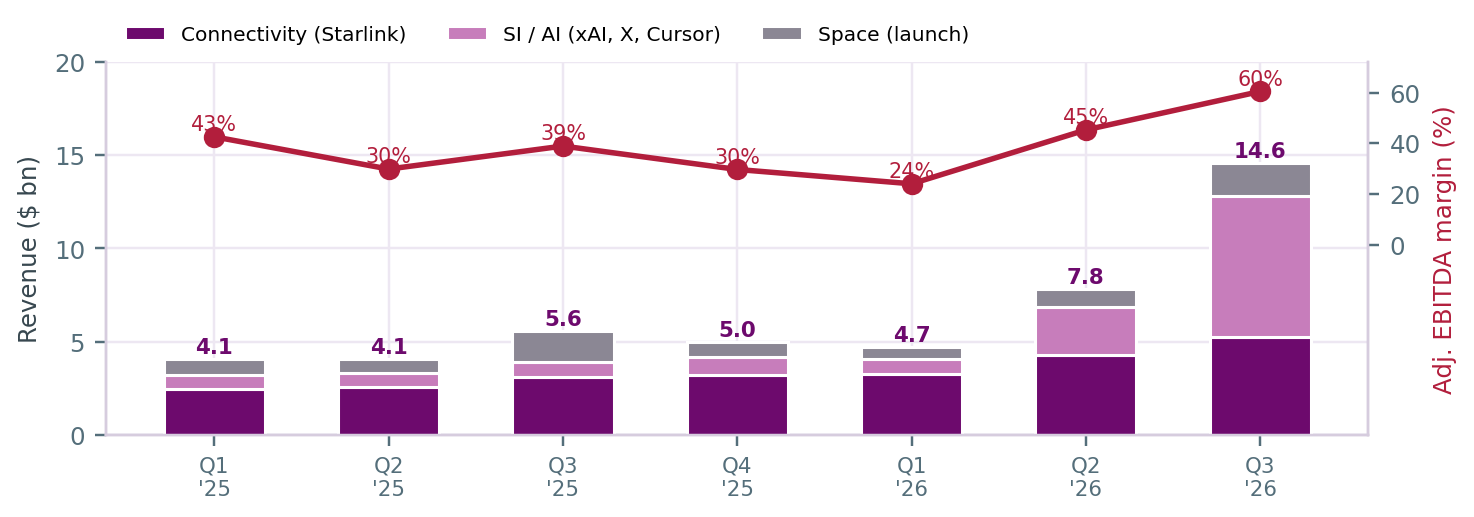
Revenue mix has flipped in one year. In FY25 Connectivity was 61% of revenue, Space 22% and AI 17%. In Q3 2026, SI was 52%, Connectivity 36% and Space 12%.
Launch. SpaceX had 170 launches and put 2,213 tonnes into orbit in 2025. Management says it carries ~90% of global mass to orbit. Most launches are internal (Starlink): 23 of the 35 in Q3. Space is loss-making (9M operating loss $1.2 bn) because of $3.2 bn of R&D, mostly Starship.
Starlink. 13.6 mn consumer subscribers in 174 markets, plus "hundreds of thousands" of enterprise users. Consumer ARPU is $69/month, down from $83 a year ago as growth tilts to lower-priced international plans. Starlink is contracted on ~12,000 aircraft (3,800 equipped), and Starlink Mobile has 22 mn monthly users.
SI. Nameplate compute was 1.7 GW at 30 September (0.6 GW a year earlier), with Colossus II in Memphis and a Southaven site coming online. Of Q3 SI revenue, $7.0 bn was "solutions & infrastructure" (cloud compute, Grok subscriptions, Cursor's $608 mn) and $0.5 bn was X advertising.
Exhibit 1: Quarterly revenue by segment and Adjusted EBITDA margin $ bn; consolidated
Source: IPO prospectus, Q2 and Q3 2026 earnings releases. Q4'25 derived as FY25 less 9M'25, and Q1'25 Adjusted EBITDA as H1'25 less Q2'25 (our calculation). Q3'26 margin includes one-time items the CFO flagged (e.g. ~3 points of tariff refunds in Connectivity gross margin).
Exhibit 2: Capex is running far ahead of EBITDA $ bn; Q4'26 = company guidance
Source: IPO prospectus, Q2/Q3 2026 releases, Q3 call (Q4 capex guidance of $35–40 bn). SI accounted for $16.4 bn of Q3 capex, Connectivity $1.5 bn and Space $1.6 bn.
What we took from the Q3 2026 call (20 Oct 2026)
Record quarter, with help below the operating line. Operating income was $2.8 bn. Net income of $4.4 bn also included $0.9 bn of interest income, $1.0 bn of other income (including a $561 mn markup on the stake in The Boring Company, which Musk controls) and a $390 mn tax benefit. SI operating income of $431 mn was after $1.2 bn of Cursor-related stock compensation.
Guidance stepped up sharply. CFO Bret Johnsen guided Q1 2027 revenue to $33–37 bn, citing "increased visibility into our compute contract pipeline." He reiterated the goal of $100 bn ARR (December revenue annualised) by end-2026 and guided Q4 capex to $35–40 bn. He also said Q4 gross margin would be closer to Q2's, because Q3 had one-time benefits.
Compute ambitions. Management expects 2.5–3 GW of nameplate compute by year-end. Musk said he is "highly confident of 10" GW of additional compute in 2027 and called 20 GW "difficult but not impossible". He then put end-2027 ARR at "somewhere between $500 billion and $1 trillion". Gwynne Shotwell's response was "On that crazy note". We do not use that range in our estimates.
Compute economics. Pricing is "slightly above the high end" of a $30–50 per watt range, with a payback of "less than a year". Musk wants to split capacity roughly 50:50 between internal use and renting it out, on short-term contracts at "effectively the spot market rate", and said renewals are coming in at higher $/watt. That is high-return if he is right about scarcity, and quick to reverse if he is not.
Funding. Asked how 13 GW gets paid for, the CFO pointed to operating cash flow, debt markets ("investment grade" status) and partners across the vendor and customer chain. Four days later SpaceX signed a binding commitment for an Apollo-managed GPU finance lease with 5-year terms (8-K, 26 Oct).
Starship. Flight 14 reached orbit and deployed 26 V3 Starlink satellites, about 10x the downlink capacity of a Falcon 9 Starlink launch. Management wants weekly flights in H1 2027 and a new Louisiana spaceport (first launch "highly likely" in 2029). Shotwell said users need "a few hundred" V3 satellites before they feel the difference, and expects that by mid-2027.
Starlink Mobile. SpaceX agreed on 8 October to buy up to 14 MHz of paired 800 MHz spectrum, closing in H1 2027, to complement the EchoStar spectrum approved earlier. Shotwell said the aim is to become "a major mobile carrier in the United States", with the V2 constellation launching in 2027 and service starting in early 2028.
Tesla. Both boards have formed special committees to evaluate a combination. Musk said assuming a deal is certain would be "overstating it" and noted that Tesla needs approval from 50% of all its shares. The 10-Q says no determination has been made.
Since the call
Flight 15 (13–14 Nov) succeeded only in part. The booster aborted its tower catch on a guidance fault and was lost offshore. Ship 42 was caught by the tower after ~22 hours, the first Starship upper stage recovered after an orbital flight (Space.com). Musk had said success on the first attempt was "more likely than not".
Board change. Class B director Donald Harrison resigned on 4 November 2026. The 8-K says this was not due to any disagreement.
Where the bear case has a point
Free cash flow is deeply negative and getting worse.
9M 2026 operating cash flow was $13.1 bn against $48.1 bn of capex, a gap of $35 bn. Adding Q4 guidance takes FY26 capex to ~$86 bn.
Net cash was $51 bn at 30 September. On our Q4 assumptions it falls to ~$22 bn by December (our calculation), before any 2027 build-out at 10+ GW.
9M operating cash flow included a $4.9 bn rise in deferred revenue, i.e. customers paying in advance.
Revenue is concentrated and contracts are short. Customer B (SI only) was 34.5% of Q3 revenue (~$5.0 bn, two-thirds of SI), and Customer A (all segments) was 16.6%. The 10-Q does not name them. Management is choosing short-term, spot-priced contracts, so revenue could reprice quickly if GPU supply catches up with demand.
Related-party financing. $12.9 bn of debt comes from failed sale-leasebacks of SI hardware with Valor Equity Partners, whose founder Antonio Gracias is a SpaceX director. Interest on it was $864 mn in 9M 2026. Q3 profit also included the $561 mn Boring Company markup.
Governance. Musk holds 82.4% of the votes and SpaceX uses the Nasdaq controlled-company exemptions. His 1.0 bn-share award vests only on market-cap milestones from $500 bn to $7.5 tn and a permanent Mars colony of at least one million people. A further 302.1 mn shares replaced his xAI award. A Tesla deal would be negotiated by two companies with the same controlling CEO.
Supply overhang. Up to 797.6 mn shares unlock on 8 December. The early release of 455.8 mn shares in August needed the stock at or above $175.50, and it closed between $108 and $125 in that window. Further tranches follow after Q4 results (351.9 mn), on 18 Mar 2027 (176.0 mn), and on 12 Jun 2027, when Musk's ~6.4 bn shares are released.
Dilution and stock compensation. Cursor brought $23.4 bn of stock awards to be expensed over ~3 years. Total share-based compensation was $3.8 bn in 9M 2026. Goodwill rose to $48.4 bn from $11.8 bn at December 2025.
Launch and Starlink pricing. Launches fell to 113 in 9M 2026 from 128 as resources shifted to Starship, and Space revenue grew only 2%. Consumer ARPU is down 17% YoY.
Our estimates $ bn
FY25A
FY26E
FY27E (base)
Revenue (growth)
18.7 (+33%)
49.1 (+163%)
170 (+246%)
Adj. EBITDA (margin)
6.6 (35.3%)
23.4 (47.6%)
85 (50.0%)
Capex
20.7
85.6
250
Adj. EBITDA less capex
(14.2)
(62.2)
(165)
Net cash (debt), year-end
n/a
22
(148)
EV / Adj. EBITDA at $140
281x
79x
21.8x
Our assumptions. FY26E: 9M actuals plus Q4 revenue of $22 bn (our estimate: a ramp towards the $100 bn December ARR goal), a 45% Q4 margin (near Q2, as the CFO indicated) and $37.5 bn Q4 capex (mid-point of guidance). FY27E: quarterly revenue of $35/40/45/50 bn (Q1 = guidance mid-point), 50% margin (9M'26 actual 49.8%). 2027 capex is not guided; $250 bn is our assumption for a ~10 GW build, part of which may be lease-financed. ~$5 bn of interest and tax. We do not forecast EPS: D&A, stock compensation and below-the-line items are moving too fast to model reliably.
SWOT analysis
Strengths
Launch near-monopoly: ~90% of global mass to orbit, 170 launches in 2025
Power, turbine and GPU supply limit the 2027 build-out
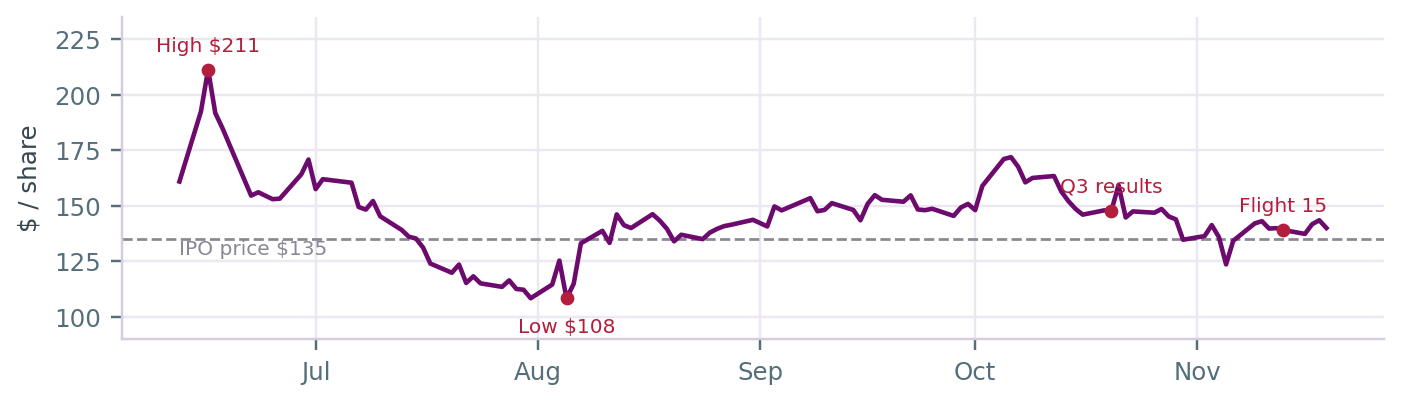
Exhibit 3: SPCX since listing $ per share; daily close
Source: Yahoo Finance daily closes, 12 Jun – 19 Nov 2026. Q3 results on 20 Oct 2026; Starship Flight 15 launched 13 Nov 2026.
Valuation: how we get to $135
Scenario
2027E revenue
Adj. EBITDA margin
2027E capex
EV / EBITDA
Net debt end-27
Per share
vs CMP
Bear: compute reprices, ramp stalls
$130 bn
40%
$150 bn
16x
$81 bn
$60
−57%
Base: guidance delivered, then +$5 bn/qtr
$170 bn
50%
$250 bn
22x
$148 bn
$137
−2%
Bull: run-rate heads towards $300 bn+
$230 bn
55%
$250 bn
28x
$106 bn
$273
+95%
Our assumptions. Equity value = EV/EBITDA multiple × 2027E Adjusted EBITDA, less estimated end-2027 net debt (from ~$22 bn net cash at end-2026), divided by 12.6 bn shares (Q3 diluted count plus a small allowance for new awards; this excludes the Mars-linked performance shares). Base case rounded down to a $135 target. The stock closed at $160.95 on its first day, peaked at $211.39 on 16 Jun and bottomed at $108.27 on 5 Aug (Yahoo Finance daily closes).
Why 22x. That is what the market pays today: an EV of $1.85 tn is 21.8x our base 2027 EBITDA. We are not paying for a re-rating. EBITDA overstates the value created while capex is more than twice EBITDA, and Customer B alone (~$5.0 bn in Q3, about two-thirds of SI revenue; our calculation) is on the short-contract SI side. Adjusted EBITDA also excludes stock compensation running at more than $5 bn a year.
Skew. The range is wide (−57% to +95%), and the bull case still assumes much less than Musk's $500 bn–$1 tn ARR range. We think a HOLD is right until there is evidence on Q1 2027 delivery and on what SI margins look like once Q3's one-time items drop out.
Catalysts: the 8 Dec lock-up expiry; Q4 results (date not yet announced), including whether the $100 bn December ARR was hit; Q1 2027 revenue against the $33–37 bn guide; the Tesla special-committee outcome; the next Starship booster-catch attempt; and closing of the 800 MHz spectrum deal (H1 2027).
We would upgrade to BUY on a pullback to ~$110 (near the August low) with guidance intact, or if Q1 2027 lands at $35 bn+ with margins at 50%+ and a credible 2027 funding plan. We would cut to SELL if compute renewals reprice lower, if Customer B's share rises further without new customers, or if a Tesla combination is struck on terms that look unfavourable to SPCX's minority holders.
Sources: Space Exploration Technologies Corp. final prospectus (Form 424B4, filed 12 Jun 2026: summary financials, segment data, MD&A, lock-up schedule, executive compensation); Q2 2026 earnings release (8-K, 4 Aug 2026); Q3 2026 earnings release (20 Oct 2026) and Form 10-Q for the quarter ended 30 Sep 2026 (filed 22 Oct 2026: notes on debt, backlog, customer concentration, related parties, the Tesla special committee); 8-Ks dated 26 Oct 2026 (Apollo finance lease) and 6 Nov 2026 (director resignation); Q3 2026 earnings call transcript (20 Oct 2026, via The Motley Fool); Space.com on Starship Flight 15 (Nov 2026); Yahoo Finance price history, fetched 19 Nov 2026. Estimates, target price, scenarios and multiples are Dart Consultants' own. Educational material only, not investment advice. Dart Consultants is not a SEBI-registered Investment Adviser or Research Analyst, nor a US-registered investment adviser or broker-dealer.
At a glance
TARGET & RATING
Rating
HOLD
12-month target
$135
CMP (19 Nov 2026)
$140.00
Upside
−4%
KEY STOCK DATA
Market cap
$1.90 tn
Shares outstanding
13.58 bn (A + B)*
IPO price (12 Jun 2026)
$135
Range since listing
$104.83 – $225.64
P/E (TTM)
n.m. (loss)
EV / TTM revenue†
57.7x
EV / Q1'27 guide ann.
13.2x
EV / Adj. EBITDA (TTM)
124x
PEG ratio‡
n.m. (0.08x fwd)
Debt / Equity§
0.22x
Price / book
10.8x
Cash + securities (Sep-26)
$89.9 bn
Debt incl. leases (Sep-26)
$38.8 bn
*Q3 diluted weighted-average count was 12.48 bn ($1.75 tn market cap). 13.58 bn likely includes ~1.30 bn unvested Musk performance shares (our reading). †EV $1.85 tn = market cap less $51.0 bn net cash. TTM revenue $32.0 bn, Adj. EBITDA $14.9 bn, net loss $2.8 bn (Q4'25 + 9M'26; our calculation). ‡GAAP PEG n.m. (TTM loss). Proxy: 21.8x EV/2027E EBITDA ÷ 264% EBITDA growth (our base). §Debt incl. leases ÷ $176.8 bn equity; net cash $51 bn. No dividend. Prices: Yahoo Finance.
OWNERSHIP & CONTROL
Class A (1 vote)
8,246.5 mn
Class B (10 votes)
5,334.5 mn
Musk votes (at IPO)
82.4%
Locked >1 year at IPO
7.8 bn (~60%)
Unlock on 8 Dec 2026
≤797.6 mn
Musk lock-up ends
12 Jun 2027
Share counts at 15 Oct 2026 (10-Q cover). Voting, lock-up and Musk holds ~6.4 bn shares incl. 350 mn Class B option shares (prospectus). "Controlled company" under Nasdaq rules.
Educational material only — not investment advice.Dart Consultants is not a SEBI-registered Investment Adviser or Research Analyst.